Showing posts with label 75011. Show all posts

12 July 2017

a farewell to meat: super, 75011


UPDATE Aug. 2nd, 2017: David Loyola tells me he has named, or renamed, his primeur "SUPER," whereas until now everyone had referred to it as Aux Deux Amis Primeur. I've updated the text below to account for the name change. 

When I first heard that 11ème wine bar Aux Deux Amis proprietor David Loyola had taken on the lease for a large adjacent space on rue Oberkampf, I shook my head in awe of what I assumed would become an extension of his popular existing wine bar. Aux Deux Amis is by all appearances a massive cash cow, turning tables from lunchtime to past midnight, the only Parisian natural wine bar of its generation to truly embrace a fun, unruly bar atmosphere. Surely on a busy thoroughfare like rue Oberkampf, I thought, bigger would mean better for Aux Deux Amis.

Instead Loyola opened a primeur, or greengrocer. It's a slightly puzzling move, given how many excellent primeurs have opened up within 5 minutes' walk within the past six months. (Le Zingam's second address on rue de la Fontaine au Roi, and Terroirs d'Avenir's new location on rue Jean Pierre Timbaud.) Loyola's greengrocer venture is probably explicable by that fact that his friend Cyril Bordarier of Le Verre Volé has already locked up natural wine retail and gourmet foodstuffs on that particular corner of rue Oberkampf, with Le Verre Volé Cave and L'Epicerie du Verre Volé, respectively. For Loyola, the options were probably primeur or nail salon.

Even so, there is already a solid primeur 100 meters up the street, and a terrible one perhaps 10 meters away. SUPER is distinguished by an impressively locavore focus - the majority of its vegetables derive from the Île de France - along with ambitious prices. It offers a small, almost stealth selection of wine and beer, as well as lunch service. At noon Loyola lords over the roomy kitchen area, improvising a daily sandwich and bento from exclusively vegetarian components. "We wanted to do no meat, and no fish, just to stay truly on theme," he explains.

25 April 2017

don't change: osteria ferrara, 75011


The similarities with between the restaurant Sicilian chef Fabrizio Ferrara opened last fall - Osteria Ferrara - and his former restaurant, the beloved Caffe dei Cioppi, are easy to recognize. At the new restaurant, an understated and tasteful redesign of the former bistrot occupant, Au Vieux Chène, one encounters the same unshowy preparations, the same loose risotto, the same divine sbrisolona, the same just-edgy-enough wine list.

It's a more interesting exercise to note what has changed. Paris, for one thing.

In the years since Caffe dei Cioppi closed, Ferrara's contemporaries Giovanni Passerini and Simone Tondo have raised the bar for Parisian Italian cuisine with their own, more expensive namesake restaurants in the same immediate neighborhood. Burrata has become as unavoidable as saucisson sec. The frighteningly-named Big Mamma Group has conquered middlebrow east Paris with a fleet of packed restaurants serving a simplistic, wincingly commercial take on pan-Italian cuisine.

In 2017, Osteria Ferrara impresses most by its quiet sense of maturity. There is ample space between the tables. From the stereo, nary a boom-bap nor a distorted chord. In the culinary hotbed of east Paris - where small-plates of offal are as common as mezcal and wine labels resemble the undersides of skateboards - sophisticated, product-driven dining can sometimes feel like the province of youth alone. Stepping into the calm predictability of Osteria Ferrara feels, in the best way, like dining at the grown-ups' table.

02 May 2016

addicted: drogheria italiana, 75011


Few industries are as plagued with inefficiencies as that of Italian specialty shops in Paris. Prices are often rapacious. And queues are often interminable, due to the hellish combination of a) widespread French unfamiliarity with even the most basic Italian foodstuffs, and b) the tendency of Italian purveyors of foodstuffs to natter on endlessly with each under-informed client. Many shops further restrict their clientele by offering opening hours that prioritise siestas. On the occasions I actually enter an Italian specialty shop in Paris, I usually exit soon after, irritated and empty-handed.

Strolling away, mentally revising whatever dinner menu I had in mind, I find myself looking forward to the semi-apocalyptic event that will occur among Italian specialty stores in Paris in 2018, when upscale Italian supermarket juggernaut Eataly is slated to open. Eataly is not cheap, of course, but in my experience the chain's quality standards are high; its product selection is immense; and on principles of economic scale alone it should be able to undercut just about everyone. This is the only instance I can think of - besides Uber and, to some extent, Amazon - where I actually support the idea of a multinational chain disrupting a heterogenous community of small purveyors. The small purveyors of Italian foodstuffs in Paris need to work faster, sell more, and stop overcharging. Never again, I hope, will I pay 7€ for a small jar of chili flakes. (This actually happened at a shop on rue Saint Maur.)

Anyway, on Judgment Day of Italian Specialty Shops in Paris, Charonne-area épicerie Drogheria Italiana will be spared annihilation. The chili flakes are more reasonable, and, far more importantly, the épicerie serves, at just six window-facing counter seats, the city's most addictive* pizza.

18 April 2016

the grown-ups' table: le petit keller, 75011


If I were ten years younger, I'd probably spend a lot of time on rue Keller. Recent years have seen a cornucopia of earnest young bars and restaurants open on this Voltaire-area side street, some pristine and intelligent (Aux Deux Cygnes), others less so (Barcardi Mojito Lab). I'd dig rue Keller's slew of vintage boutiques, book shops, and records shops, and the curious contrast between the innocence of these endeavors and the heavily-armed soldiers patrolling the street for the safety of its most famous and incongruous resident, Prime Minister Manuel Valls.

As things stand in this lifetime, however, I haven't spent much time on rue Keller. I do most of my shopping on Amazon, and when I dine out, I seem to gravitate towards businesses run by my elders. My reasoning for the latter is simple: I have more to learn from them. Paris' younger bars and bistrots can blur together at times, particularly if, as is often the case, they're sourcing their wines from the same handful of agents.

But now rue Keller, too, is growing up. The celebrated Franco-Japanese chef Kaori Endo (ex-Nanashi, ex-Rose Bakery) and her husband, the hyper-discreet O.G. natural wine caviste Michael Lemasle (Crus et Découvertes), have transformed quaint bistrot Le Petit Keller into something new and intriguing in the Paris restaurant scene. With ambitious opening hours, refined cuisine drawing equally on western health-consciousness and eastern home-cooking, and a smart natural wine list, the new Le Petit Keller is a savvy small-plates restaurant that dials down the masculine indulgence of the format without sacrificing an iota of sophistication.

13 April 2016

sign of the times: jones, 75011


When the partners involved in Voltaire gastronome-magnet Restaurant Bones decided to go their separate ways last summer, remaining co-owner and Père Populaire kingpin Florent Ciccoli considered selling the business. Instead, after what seemed like months of faintly dubious "close-out" sales of the restaurant's wine cellar, Ciccoli decided to hop in the kitchen himself and reopen the restaurant with a very, very slight name change.

It's a daring move for a number of reasons, not least because very few chefs would relish withstanding direct comparison with the sophisticated culinary highs of previous chef James Henry. But a flair for improvisation has long been both the Pères Populaires group's greatest asset and its most wobbly liability.

For anyone wondering, Ciccoli's cuisine at the newly-rebaptised restaurant Jones does not withstand direct comparison to Henry's at Bones. But nor should it. Jones succeeds most convincingly where it departs most from the former restaurant's blueprint. Gone is Bones' sometimes churlish service; gone is the maximalist glass-pour selection; gone are set-menus and mandatory reservations. What one finds in place of these things is an inviting and unpretentious spot for free-form, last-minute dinners, enlivened by an undiminished natural wine list and, one presumes, many of the former restaurant's product purveyors. The populist format fits the times: the citizens of Paris' 11ème arrondissement can be proud that, in 2016, things like skin-macerated Savoie wines and fish heads have become almost mainstream.

08 February 2016

save this bar: jéroboam, 75011


Pity the lonely aficionado. Imagine being possessed of knowledge and good taste, in a given subject, and yet being condemned, for want of similarly-inclined fellowship, to forever share one's passion with ciphers, suits, and passers-by.

If you have imagined this, it gives you a good foretaste of the potential tragedy of 11ème wine shop and wine bar Jéroboam. Owner Vincent Fiorani made his career in manufacture of children's toys. Until opening Jéroboam last year, he indulged his passion for wine as a partner in 17ème arrondissement wine shop Coureurs de Terroirs. When that association ran its course, he decided to launch himself full-time in wine.

Jéroboam is the result. The establishment counts among its assets an excellent, Marais-adjacent location; a vast, well-priced selection of less-than-obvious wines, including many natural wines and impressive back vintages; and simple, good-value boards of charcuterie, cheese, and cured fish. All of this is, unfortunately, delivered with the earnest marketing blather of a Wall Street English program.

15 January 2016

a quiet revolution: le zingam, 75011


When Voltaire-area greengrocer Le Zingam first opened in April 2014, I gave it a wide berth, because it seemed like yet another overpriced organic-locavore bear-trap. A messenger bicycle forms part of the outdoor vegetable display, while the interior's rough-hewn furniture recalls Big Sur. Proprietors Sonny Lac and Lelio Stettin are two young guys from the neighborhood whose combined food and wine experience could be recorded on the back of a short receipt. (Lac used to work at folkloric neighborhood wine bistrot Mélac.)

I first visited Le Zingam simply because it was open Sunday. It was far less expensive than I anticipated. A year or so later, I realised, in something like astonishment, that Lac and Stettin's little shop has slowly taken over my entire diet. Its products have all become staples: its trios of slender saucisses, its tomme de chèvre and its Saint Nectaire, its Sicilian clementines, its yogurt pots, its onions, its turnips and leeks, its craft beers, its natural wines. For foodstuffs I no longer shop anywhere else, save for the occasional foray to Belleville for Asian and Middle-Eastern ingredients.

In their surprisingly astute product selection and their ironclad commitment to affordability, Lac and Stettin have done something that runs up against my most basic principles as a Parisian consumer: they've created a place that supersedes the weekly street markets. Le Zingam's products are better, and just as cheap, if not cheaper.

11 August 2015

clowns: clown bar, 75011


To me, clowns aren't funny. In fact, they're kind of scary. I've wondered where this started and I think it goes back to the time I went to the circus, and a clown killed my dad. - Jack Handey

My distrust of Ewan Lemoigne and chef Sven Chartier's work goes back to the time Lemoigne botched my reservation at Saturne. Had Lemoigne handled the situation with any decency, I would've simply returned some other time. As it was, I didn't return to Saturne for over three years, until a magazine paid for my lunch there in March.

I just wanted no part of supporting such an inhospitable hospitality group. Until recently I was boycotting the Saturne duo's newer project, rue Amelot's Clown Bar, for the same reasons. Friends in the Paris restaurant scene, in efforts to persuade me to try Clown Bar chef Astumi Sota's lauded cuisine, would invariably arrive at the phrase, "But Ewan's not even there!"* I wouldn't budge, preferring instead to support nicer people at neighboring places like Repaire de Cartouche, Au Passage, Pas de Loup, Aux Deux Amis, and Le Tagine.

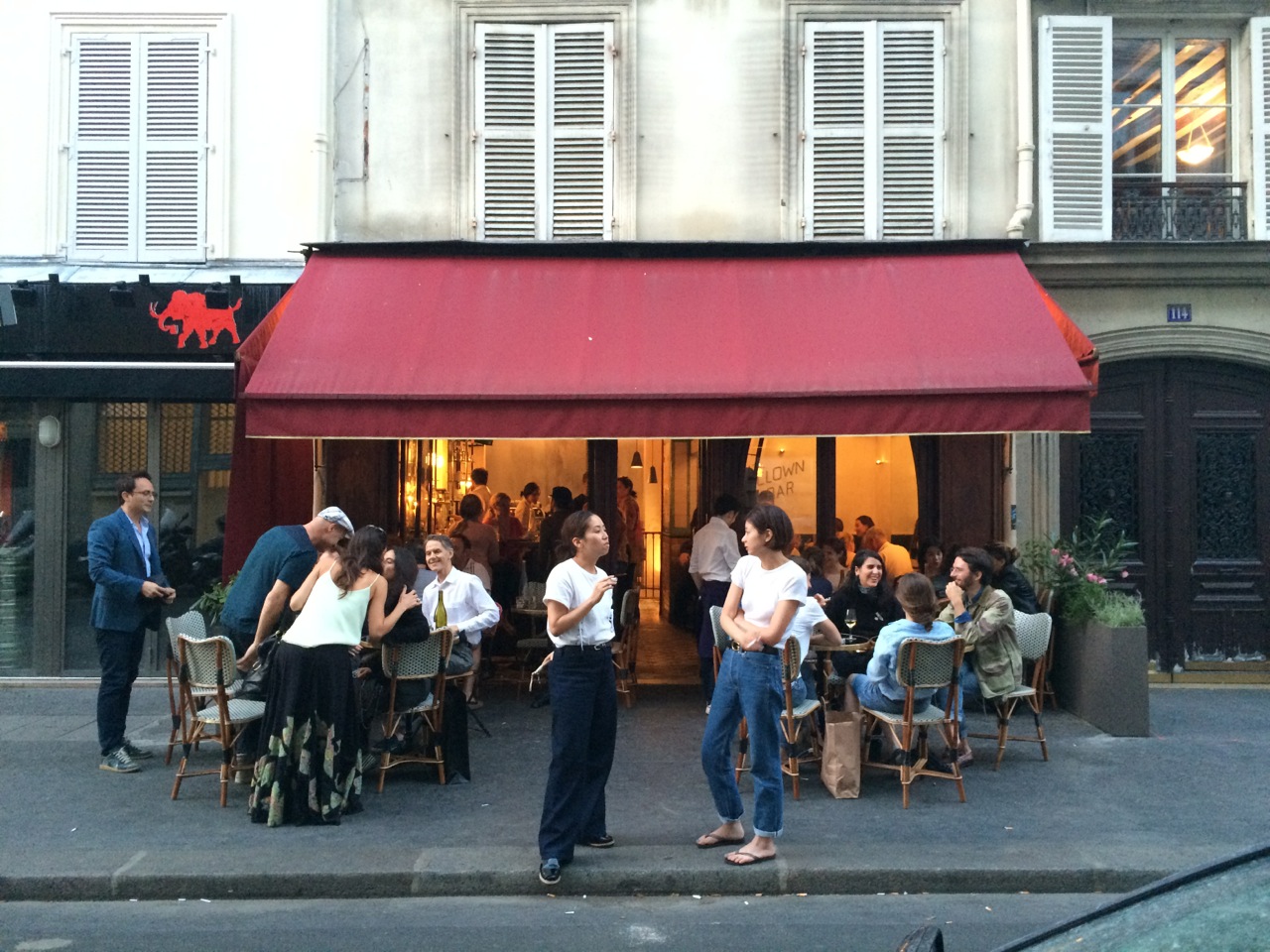
But hell, time passes. I'm about to leave Paris for a few months and I'd like to leave all grudges behind. Lunch at Saturne was excellent in March: I left utterly convinced of Sven Chartier's talents. And despite my differences with Lemoigne, I can certainly applaud the wine list he assembled at Saturne, which ranks among the city's best. Clown Bar, for its part, is a worthy addition to Paris' dining scene, offering an unmistakably upmarket experience of fine cuisine and natural wines in a pleasantly versatile format: small plates, Sunday service, a big terrace, a bar. True, it's more expensive than all its stylistic peers. But Paris has an under-served constituency who want that.

15 June 2015

conscientious objectors: les déserteurs, 75011


As diners and critics, we're willing to discern greater depths in a chef's plates if he or she has led a swashbuckling lifestyle, or at least can be presented to us as having witnessed the mysteries of foreign cultures. In contemporary Paris, the résumé spice du jour is "travel in Asia," a transcendant, cuisine-altering experience for chefs ranging from David Toutain to Saturne's Sven Chartier to Le Servan's Tatiana Levha. If, of that list, only Levha's cuisine shows any direct engagement with eastern cuisines, don't blame the chefs. Blame their publicists, and culinary media outlets.

Les Déserteurs, the upscale market-menu restaurant opened last year by chef Daniel Baratier and sommelier Alex Céret in the former Rino space on rue Trousseau, is, like its chef, deficient in narrative flair. The name is a witticism referring to the owners' former workplace, the untrendy Ile Saint Louis Michelin one-star Le Sergent Recruteur, a restaurant that I now read is in liquidation. When the joke passes, we're left with the following premise: Two Friendly French Guys Open Slightly Pricey Restaurant.

Diners will be forgiven for not leaping to book six-tops. I myself only went because they had a last minute table on a Saturday night, and I often work in the neighborhood. I was therefore caught entirely by surprise by the restaurant's outright excellence. From its pacing to its apportionment to its marvelous contents, a meal at Les Déserteurs is a tour de force of sensitivity, where the refined, vegetable-driven country cuisine is as nuanced and mature as the wine list.

05 June 2015

back yard: yard wine bar, 75011


When I first wrote about Jane Drotter's splendid contemporary bistrot YARD in April 2014, I couldn't help expressing astonishment that some of the passing Père Lachaise locals found prices too high. "Stinting flintnosed cheapskates," I called them. YARD the restaurant was then and still remains one of the city's best deals, its prices calibrated more to the expectations of its far-flung quartier than to the skills of chef Nye Smith or the superior quality of his product.

Drotter, presumably as part of a grand strategy for domination of nightlife in the eastern 11ème, has now opened, beside her bustling bistrot, YARD Wine Bar, a cosy roomful of high tables and a wide terrace where she continues to indulge her clientele. The small-plate menu prices are lower than those of most soft beverage programs in the Marais.

It's worth noting, though, that Drotter's clientele has changed. Where once it consisted of whoever happened to live or work nearby, it now resembles a cross-section of the Paris fine restaurant crowd, which is to say, chiefly people who unhesitatingly order the whole menu twice and consume oceans of natural wine. This dynamic, one hopes, will sustain YARD Wine Bar's paradisiacal micro-scene for many summers to come.

20 April 2015

time is nye: yard, 75011


A friend who edits a fashion magazine once said to me, apropos of my blog, "I love it. But I never have any idea what you're talking about or whether you like a place. Could you just put a rating at the top or something?"

I've never been tempted to do this, because it would imply a hierarchical order to restaurant experiences that simply isn't there. I have however long been tempted to publish a running list of the Paris restaurants to which I find myself returning most often.*

In pride of place on this list, lately, is YARD, Jane Drotter's ever-evolving jewel of a bistrot by Père Lachaise. The cuisine used to be homey and neighborly under chef Fabrice Mellado. Then Australian chef Shaun Kelley arrived in spring of last year and emblazoned the address in the Paris dining firmament by dint of his ultra-contemporary kitchen smarts. Kelly passed like a comet, however, moving on too soon to make much impact, and since last November, YARD's kitchen has been run by young British chef Nye Smith. Belying his youth, and a résumé includes stints at London hotspots Moro and Koya, Smith's cuisine at YARD is neither precocious nor internationalist. Less austere than that of his predecessor, perceptibly more pleasure-oriented, it strikes a balance between sophistication and accessibility that couldn't be better suited to YARD. I think it's this rare synergy, combined with Drotter's expanding natural wine list and peerless hospitality, that makes each visit a uniquely enjoyable experience.

* List duly included after the jump.

24 March 2015

symbiosis: la cave du daron, 75011


For better or worse, the fate of tiny 11ème arrondissement caviste and wine bar La Cave du Daron seems intimately linked to its famous neighbors across avenue Parmentier. Inaki Aizpitarte's ubiquitously publicized triumvirate of Le Chateaubriand, Le Dauphin, and Le Cave are like the Great Whites Sharks of Goncourt, leaving the impossibly low-key La Cave du Daron to perform a remora-like function, living off the overflow.

I lived three blocks away for four years, and for all that I appreciated owner Jean-Julien Ricard's varied and intelligent wine selection, I could never think of much to say about the place. It's the size of a sardine tin, comprising just eight or so seats. Small snacks of prepared foodstuffs are available. While Ricard organises semi-frequent events with outside chefs, including Maori Murota (ex-La Conserverie, presently making lunches at Le Verre Volé Sur Mer) and Adeline Grattard (of Yam Tcha), La Cave du Daron's miniscule size pretty much restricts their audience to the hardcore fanbase of the visiting chef in question.

Ricard, too, has a loyal fanbase of young professionals who populate the bar during apéro hours. If I'm quite late in joining the party, it's because his wine prices can be a little high. What changed, then, to make me visit the other evening, and finally discover the charm of La Cave du Daron? Well, in the time since I praised the utility and simplicity of apéros at Aizpitarte's Le Cave, that wine shop has stopped serving bottles on premises, leaving La Cave du Daron as the block's only option for fine wine consumption without the attendant obligation of expensive cuisine. Modest and welcoming, Ricard is well-suited to the role he's found, as the Goncourt local's favorite low-key foil to the brouhaha across the street.

12 February 2015

effortless success: martin, 75011


With Au Passage currently topping many critics most-visited lists (including mine), it's easy to forget that, before James Henry got involved almost by accident, the extended Pères Populaires family of establishments had evinced no ambitions towards fine restaurateurism whatsoever. Commercially-minded American bystanders like myself might expect that, having succeeded at winning a high-value clientele, the Au Passage team would continue to cater to them. 

But as of last December, we have the Au Passage team's perplexing stepchild Martin, an almost confrontationally détendu bar serving small plates in a largely unrefurbished space on windy boulevard du Temple. Named after its genial co-owner Loic Martin, who formerly bartended at Au Passage, Martin the restaurant reminds us that we have fundamentally misunderstood these people. 

I think, in the wake of Pères Populaires' Bones, everyone was expecting the Au Passage team, on their own this time, to launch something similarly savvy, festooned with hip signifiers. Instead, Martin is a discreet, welcoming, and forthrightly egalitarian little all-day bistrot, aimed at inadvertent tastemakers like themselves - those who have certain standards, with regards to food and wine, but who don't need to see them exceeded at every meal. In season when quality-conscious Paris restaurant projects seem ubiquitously to open guns blazing with 65€ five-course tasting menus, Martin is gloriously off-trend, and kind of a godsend. 

01 September 2014

coming round again: à la renaissance, 75011


Like any frequent host in Paris, I've learned to grin vacantly through inarticulate endorsements of "little neighborhood bistrots," those magical gold pots every tourist manages to discover at the end of the RER B rainbow. What our clients, friends, and relatives are discovering is usually not quality, but cuteness, for when one arrives in Paris from a New World nation, almost everything appears quite shrunken, frank, and twee. 

Whereas, in reality, the odds of stumbling upon a unambitious, mostly unknown establishment serving sincere and reasonably well-informed food and wine in Paris - the most visited and most discussed restaurant scene on earth - are vanishingly small.    

Yet, astonishingly, that is how I and my friend and colleague Meg Zimbeck of Paris by Mouth both independently came upon A La Renaissance, an anachronistic 11ème bistrot which, in all aspects save prices and opening hours, resembles its anonymous small-town-square archetype. That we hadn't heard of A La Renaissance before wouldn't be surprising, were it not for bistrot's massive natural wine list, and the fact that, almost alone among Paris natural wine spots, it is open past midnight seven days a week. In the revitalized Voltaire area, newly studded with destinations like Septime, Clamato, Bones, and Le Servan, A La Renaissance is an under-acknowledged pioneer.

20 August 2014

the anti-nicolas: squatt wine shop, 75011


A chef friend whose opinions I value highly once raised a sceptical eyebrow when I praised La Retrobottega proprietor Pietro Russano's cooking. At the time Russano, a former sommelier at the late restaurant Rino, had just opened his low-key 11ème Italian cave-à-manger and, as is often still the case today, he was manically performing all roles: sommelier, server, host, and cook. My chef friend argued his cuisine was too untutored.

I had no rebuttal, because it's true Russano is mostly self-taught. If the dishes I've received since at La Retrobottega rarely reach the heights of the magnificent pickled squash salad Russano served on my first visit, they're nonetheless reliably soulful, curious preparations: roast aubergine atop couscous, or burrata served with mango, white mushroom and chive. Russano is an improvisation artist, if not in the high-jazz register of the greatest chefs, then in the blustery, street-level manner of a freestyle MC.

This is the best lens through which to understand his new project, a junkyardy wine shop and épicerie on rue de la Roquette that he has rather pungently entitled Squatt Wine Shop. (Two t's intentional.) Russano explains the name is a reference to squatter culture in places like Berlin. I'm unable to resist observing that 'squat' is also what dogs do in the street in places like Paris, or that it's what one finds in one's bank account after too many wine expenditures... No, the word has no good connotations in English. Perhaps Russano's wine shop will be the first, for Squatt is overstuffed with unusual French and Italian selections, not to mention sincere personality, making it the antithesis of Paris' ubiquitous Nicolas chain, one location of which is, amusingly, located directly next door.

30 July 2014

swans' way: aux deux cygnes, 75011


My friend M is a Vietnamese chef in New York. A year ago I was encouraging him to open a restaurant in Paris. Just think, I beamed. Natural wine and Vietnamese food ! It's never been done ! Moreover, such a restaurant would perform the conceptual two-step necessary in contemporary Paris to appeal both to Parisians, who hunger for novel, non-Parisian things, and visitors, for whom all things Parisian are novel. For an unintended consequence of France's imperialist adventures in Asia is that, a century and a half later, it seems plausible that Paris would contain excellent Vietnamese food.

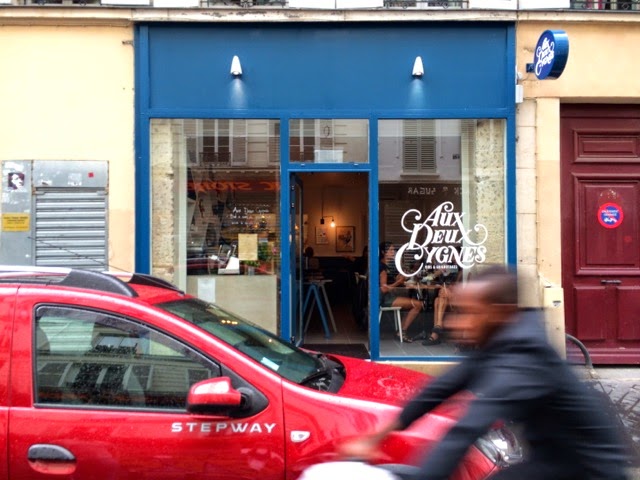
Aux Deux Cygnes, a well-appointed dollhouse of a wine bar on rue Keller opened three months ago by polyvalent young French-Vietnamese restaurant professional To Xuan Cuny, is not a destination for excellent Vietnamese food. Instead it's a very personal effort, a synthesis of Cuny's influences, to which world-historical forces are mostly incidental. Even the bar's elegant name is simply a play on words, a French translation of the common Danish mispronunciation of Cuny's first name. ('Two swans.') The Vietnamese angle largely stops with the bar's somewhat bread-driven bánh mì. So there's still room for my old friend M in Paris.

If Aux Deux Cygnes, with its tiny snack menu and appreciably offbeat, southern-focused wine list, nonetheless feels rather new, it's because Cuny herself represents an inroad of Michelin-trained hospitality experience to the historically scruffier field of natural wine in Paris.

23 July 2014

not idiots: le cave, 75011


I thought it would be bigger news when late last year Inaki Aizpitarte opened a shoebox-sized wine shop between Le Chateaubriand and Le Dauphin. Instead, outside of a few blurbs in the French press, it was basically a non-event. Curiously, and rather appealingly, this seems to have been intentional.

You have the shop's almost Google-proof name, Le Cave, a French pun* that doesn't scan in English. You have the shop's quixotic concept, which is to offer exclusively non-French natural wines. You have the fact that food is sold to-go, but no food is available for consumption on premises - not a cheese rind, not the barest sliver of charcuterie. Yet a rotating cast of the shop's exotic, borderline faddish wines are available by the glass.

What does Le Cave offer that could possibly make it a destination ? Nothing. And I imagine this suits the Chateaubriand group fine, since their two adjacent restaurants already have enough overflow to require the services of a waiting room, which is Le Cave's primary function. Happily, staffing what could easily have been a lean mean man cave is a razor-sharp lady called Beatrice, who, seemingly alone in the restaurant group, has serious hospitality skills. And so Le Cave becomes, despite itself, a low-key weeknight destination, one which I prefer to both restaurants.

06 May 2014

reign of terrine: repaire de cartouche bar à vin, 75011


Who knew what to expect when chef Rodolphe Paquin, le roi de la terrine, announced he was turning his divisive bistrot Le Repaire de Cartouche's rue Amelot dining room into a wine bar ?

Paquin's friend and peer Thierry Breton opened his own bar à vin last summer, La Pointe du Grouin, to strange, circusey results. As much as I enjoy that bar, it's representative of a tendency among French restaurateurs - even ones as free-thinking as Breton - to view customer service as a binary proposition, either on or off, present or completely, chaotically absent.* Very rarely in Paris does one encounter the nuanced, calibrated dynamics of places like Septime Cave, Clamato, Le Mary Celeste, or Camille Fourmont's Buvette, younger concepts by younger, hungrier restaurateurs who are now inspiring their forebears.

With Le Repaire de Cartouche Bar à Vin, Paquin proves he hasn't been snoozing for the last 17 years since he opened his restaurant. His wine bar demonstrates an awareness of all that makes Paris' other contemporary wine bars great: a small, responsive menu of shareable items, a long, cornered bar you can actually use, an open door to the street for standing and smoking. But Le Repaire de Cartouche Bar à Vin has three striking advantages over the others: Rodolphe Paquin himself, his bistrot's national-treasure wine list, and his lauded terrines, which latter are among the greatest examples of France's original bar food.

29 April 2014

worth the wait: le servan, 75011


Two observations on restaurant service, following a meal at Le Servan, the spiffing new restaurant on rue Saint Maur by the charming and demure Levha sisters, Tatiana and Katia.

One is that I much prefer the ambiance in restaurants run by women. Natural wine bistrots have for too long been the province of grouchy old men and churlish young guns more attentive to their facial hair than to guests. With Haruka Casters' 6036, Jane Drotter's newly revamped Yard Restaurant, and now Le Servan, diners of the 11ème arrondissement are treated to a preview of what I sincerely hope will become the preferred service standard citywide. Service at Le Servan is unfailingly good-natured; staff are happy to share Tatiana's subtly Asian-inflected cuisine and Katia's boutique natural wine list.

The other observation is that a terrific meal at a restaurant, like a certain other very enjoyable act, can turn unpleasant if it goes on too long. At a certain point, it doesn't matter how seductive the appetisers are, nor how climactic the main courses might be. Even at the most promising of restaurants, when an hour passes between courses, friction occurs.

15 April 2014

return to sender: blue valentine, 75011


At the restaurant I used to manage in Los Angeles, we had an amusing problem. One of the owners was friends with R.E.M., and accordingly that band featured heavily on the mandated nightly playlist. But the members of R.E.M. came into the restaurant relatively often. Whenever we got wind of their arrival, we had to be absolutely sure to switch to a non-R.E.M. playlist, to avoid the cosmic embarrassment that would ensue if the band walked in while their own songs were playing. In such a circumstance (for it did indeed occur once or twice) the entire restaurant comes off looking like the guy wearing the band's t-shirt to the concert.

So, what if you've named your restaurant after a classic Tom Waits song, and then you play Tom Waits all the time in your restaurant? This is lame before Tom Waits even sets foot in the door.

Luckily for the owners of newish Republique restaurant Blue Valentine, that problem is easily fixed. Unfortunately, it's representative of the restaurant's entire concept, which is almost unsalvageable. Blue Valentine is a clumsy attempt to ride contemporary restaurant trends without understanding any of them. Cocktail service, a magnum-only, mostly natural wine list, rock music, and a market menu helmed by a Japanese chef. Woau! But it's like the owners were told about these elements cohering successfully in other restaurants, and then the owners gamely tried to replicate the blend themselves, without first examining any other restaurants.* The result is a pitifully inauthentic experience, one of the most embarrassing meals I've had in years. I felt like the intended target of seduction by a college freshman.