Showing posts with label italian cuisine. Show all posts

25 April 2017

don't change: osteria ferrara, 75011


The similarities with between the restaurant Sicilian chef Fabrizio Ferrara opened last fall - Osteria Ferrara - and his former restaurant, the beloved Caffe dei Cioppi, are easy to recognize. At the new restaurant, an understated and tasteful redesign of the former bistrot occupant, Au Vieux Chène, one encounters the same unshowy preparations, the same loose risotto, the same divine sbrisolona, the same just-edgy-enough wine list.

It's a more interesting exercise to note what has changed. Paris, for one thing.

In the years since Caffe dei Cioppi closed, Ferrara's contemporaries Giovanni Passerini and Simone Tondo have raised the bar for Parisian Italian cuisine with their own, more expensive namesake restaurants in the same immediate neighborhood. Burrata has become as unavoidable as saucisson sec. The frighteningly-named Big Mamma Group has conquered middlebrow east Paris with a fleet of packed restaurants serving a simplistic, wincingly commercial take on pan-Italian cuisine.

In 2017, Osteria Ferrara impresses most by its quiet sense of maturity. There is ample space between the tables. From the stereo, nary a boom-bap nor a distorted chord. In the culinary hotbed of east Paris - where small-plates of offal are as common as mezcal and wine labels resemble the undersides of skateboards - sophisticated, product-driven dining can sometimes feel like the province of youth alone. Stepping into the calm predictability of Osteria Ferrara feels, in the best way, like dining at the grown-ups' table.

02 May 2016

addicted: drogheria italiana, 75011


Few industries are as plagued with inefficiencies as that of Italian specialty shops in Paris. Prices are often rapacious. And queues are often interminable, due to the hellish combination of a) widespread French unfamiliarity with even the most basic Italian foodstuffs, and b) the tendency of Italian purveyors of foodstuffs to natter on endlessly with each under-informed client. Many shops further restrict their clientele by offering opening hours that prioritise siestas. On the occasions I actually enter an Italian specialty shop in Paris, I usually exit soon after, irritated and empty-handed.

Strolling away, mentally revising whatever dinner menu I had in mind, I find myself looking forward to the semi-apocalyptic event that will occur among Italian specialty stores in Paris in 2018, when upscale Italian supermarket juggernaut Eataly is slated to open. Eataly is not cheap, of course, but in my experience the chain's quality standards are high; its product selection is immense; and on principles of economic scale alone it should be able to undercut just about everyone. This is the only instance I can think of - besides Uber and, to some extent, Amazon - where I actually support the idea of a multinational chain disrupting a heterogenous community of small purveyors. The small purveyors of Italian foodstuffs in Paris need to work faster, sell more, and stop overcharging. Never again, I hope, will I pay 7€ for a small jar of chili flakes. (This actually happened at a shop on rue Saint Maur.)

Anyway, on Judgment Day of Italian Specialty Shops in Paris, Charonne-area épicerie Drogheria Italiana will be spared annihilation. The chili flakes are more reasonable, and, far more importantly, the épicerie serves, at just six window-facing counter seats, the city's most addictive* pizza.

20 August 2014

the anti-nicolas: squatt wine shop, 75011


A chef friend whose opinions I value highly once raised a sceptical eyebrow when I praised La Retrobottega proprietor Pietro Russano's cooking. At the time Russano, a former sommelier at the late restaurant Rino, had just opened his low-key 11ème Italian cave-à-manger and, as is often still the case today, he was manically performing all roles: sommelier, server, host, and cook. My chef friend argued his cuisine was too untutored.

I had no rebuttal, because it's true Russano is mostly self-taught. If the dishes I've received since at La Retrobottega rarely reach the heights of the magnificent pickled squash salad Russano served on my first visit, they're nonetheless reliably soulful, curious preparations: roast aubergine atop couscous, or burrata served with mango, white mushroom and chive. Russano is an improvisation artist, if not in the high-jazz register of the greatest chefs, then in the blustery, street-level manner of a freestyle MC.

This is the best lens through which to understand his new project, a junkyardy wine shop and épicerie on rue de la Roquette that he has rather pungently entitled Squatt Wine Shop. (Two t's intentional.) Russano explains the name is a reference to squatter culture in places like Berlin. I'm unable to resist observing that 'squat' is also what dogs do in the street in places like Paris, or that it's what one finds in one's bank account after too many wine expenditures... No, the word has no good connotations in English. Perhaps Russano's wine shop will be the first, for Squatt is overstuffed with unusual French and Italian selections, not to mention sincere personality, making it the antithesis of Paris' ubiquitous Nicolas chain, one location of which is, amusingly, located directly next door.

11 February 2014

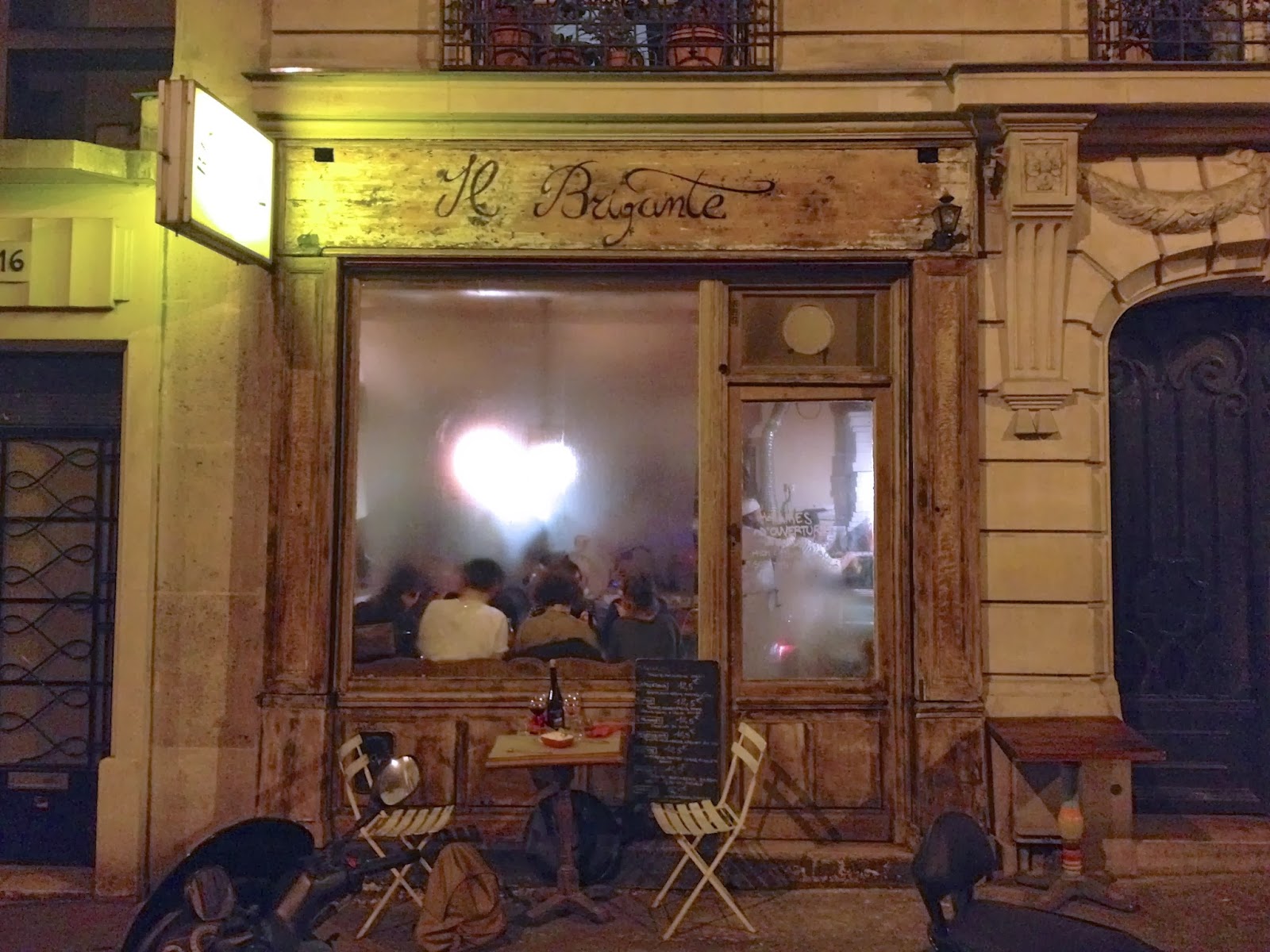
parisian pizza: il brigante, 75018


As a foreigner in Paris of a certain profusely fertile age group, I often wonder what it would be like to raise a child here. These reveries fill me with dread. One day I would wake up surrounded by an ideologically French family. It's cute when French toddlers obediently proffer their cheeks to relative strangers for goodnight kisses before toddling off to bed. It's less cute when French employees explain they took a fourth cigarette break because they needed a little pause.

And it's frankly pathetic that over half the country agrees that François Holland's right to philander with spectacularly clumsiness shouldn't be questioned by journalists. The President's recent press conference reminded me of the climactic scene from the Wizard of Oz: "Pay no attention to the man behind the curtain." (To which the obvious response is, if you want us to do that, you should begin by keeping it behind the curtain.)

But sometimes I wonder if I'm becoming indoctrinated, too. I already demand room-temp cheese and fresh bread wherever I go, which means I can't live anywhere else in the world. And a real red flag went up the other day, when at the devilishly charming Montmartre restaurant Il Brigante I genuinely enjoyed a locally popular foodstuff I've heretofore foresworn entirely: Parisian pizza.

29 January 2014

why we dine out: come a casa, 75011


I still read Pitchfork. But since it now takes less time to download albums than it does to parse reviews, I usually just peek at the point score and make the call myself. I find it's a good way to avoid the publication's increasingly boosterish take on certain handpicked darling bands, a trend that began with Deerhunter and has reached self-parodical peaks with coverage of Savages and Perfect Pussy.*

This past December, Pitchfork cited Perfect Pussy's slight 4-song demo as among the Honorable Mentions for Albums of the Year. When I played it for my friend C, a young gallerist from New Zealand, she wrinkled her nose. "Yeah Bikini Kill blah blah blah, we've heard this before." We agreed that Pitchfork was having an NME moment, a paroxysm of hyperbolic hype about something totally unproven, deriving from the writerly impulse to say things messianically.

Editors are supposed to throw cold water on that sort of thing. The task is arguably more important in food and wine journalism, since readers can't (yet) choose to simply download a meal. It always costs money and time. Quite a few Paris food writers recently had their own NME moments over a shoe-sized Tuscan restaurant by Voltaire called Come a Casa. I duly dined there and came away slightly disappointed - not by the meal, which was basically as advertised, but by Paris food writing.

24 May 2013

the ideal : caffè dei cioppi, 75011


In the same way that many fine-dining waiters wish to be wizards whose assistants, the busser staff, do all actual plate-clearing, many restaurateurs aspire to invent Perpetual Motion Machines. It's the ideal restaurant: a motor that runs itself, free of vindictive neighbors, staff orgies, mass poisonings, or any of the other baroque malfunctions that can trip up a business and consume the sanity of its management. Ironically,  efforts to actually build Perpetual Motion Machine restaurants usually come at the expense of things like soul and hospitality and food quality. Whether we like it or not, these things won't run on inertia alone.

But I suspect there's another way to build a Perpetual Motion Machine. It's by being skilled and loving one's business and not, in fact, wishing to build a PMM as a means of absenting oneself from its daily workings.

Miniscule and modest, 11ème arrondissement Italian restaurant Caffè dei Cioppi would seem to exemplify this business model. Chef-owner Fabrizio Ferrara has for the past four years been garnering great reviews merely for offering actual serious Italian food to Parisians at fair prices, accompanied by well-chosen honest wines. The menu changes at the pace of a glacier; nothing is controversial; everything runs like a dream. The only thing more astonishing than the fact that no one else in Paris has replicated Ferrara's blueprint is that Ferrara himself has not replicated Ferrara's blueprint.

10 May 2013

ma dai ! : procopio angelo, 75010


There would not, initially, seem to be much purpose in my writing anything at all about Procopio Angelo, the eponymous restaurant of a popular Tuscan chef in Paris, once based on rue Faubourg St. Honoré, now transplanted to a back road near Colonel Fabien in the 10ème. Procopio's Italian wine list is representative of the genre as one typically encounters it in Paris: a seeming panoply of regional wines, which upon closer inspection turn out to comprise little more than the diverse ranges of a few titanic producers of supermarket wine. Then you have poor Marco Parusso's decent if overmodern Barolos - always the current vintage - sitting there like duck-decoys for the big spenders who stray in.*

But Procopio keeps cropping up in any discussion of Italian food in Paris. No less than two friends whose culinary opinions I otherwise respect have proposed his restaurant to me as an example of "real Italian."

Sociologist Peter L. Berger famously argued that reality itself is a social construction, an interwoven fabric of institutionalised social perceptions. Procopio Angelo is real Italian cuisine, if, like many Paris diners, one disregards the last twenty years' of Italian restaurateurism and continues to define Italian cuisine in opposition to the technique and complexity of a serious restaurant.