Showing posts with label italian wine. Show all posts

25 April 2017

don't change: osteria ferrara, 75011


The similarities with between the restaurant Sicilian chef Fabrizio Ferrara opened last fall - Osteria Ferrara - and his former restaurant, the beloved Caffe dei Cioppi, are easy to recognize. At the new restaurant, an understated and tasteful redesign of the former bistrot occupant, Au Vieux Chène, one encounters the same unshowy preparations, the same loose risotto, the same divine sbrisolona, the same just-edgy-enough wine list.

It's a more interesting exercise to note what has changed. Paris, for one thing.

In the years since Caffe dei Cioppi closed, Ferrara's contemporaries Giovanni Passerini and Simone Tondo have raised the bar for Parisian Italian cuisine with their own, more expensive namesake restaurants in the same immediate neighborhood. Burrata has become as unavoidable as saucisson sec. The frighteningly-named Big Mamma Group has conquered middlebrow east Paris with a fleet of packed restaurants serving a simplistic, wincingly commercial take on pan-Italian cuisine.

In 2017, Osteria Ferrara impresses most by its quiet sense of maturity. There is ample space between the tables. From the stereo, nary a boom-bap nor a distorted chord. In the culinary hotbed of east Paris - where small-plates of offal are as common as mezcal and wine labels resemble the undersides of skateboards - sophisticated, product-driven dining can sometimes feel like the province of youth alone. Stepping into the calm predictability of Osteria Ferrara feels, in the best way, like dining at the grown-ups' table.

02 May 2016

addicted: drogheria italiana, 75011


Few industries are as plagued with inefficiencies as that of Italian specialty shops in Paris. Prices are often rapacious. And queues are often interminable, due to the hellish combination of a) widespread French unfamiliarity with even the most basic Italian foodstuffs, and b) the tendency of Italian purveyors of foodstuffs to natter on endlessly with each under-informed client. Many shops further restrict their clientele by offering opening hours that prioritise siestas. On the occasions I actually enter an Italian specialty shop in Paris, I usually exit soon after, irritated and empty-handed.

Strolling away, mentally revising whatever dinner menu I had in mind, I find myself looking forward to the semi-apocalyptic event that will occur among Italian specialty stores in Paris in 2018, when upscale Italian supermarket juggernaut Eataly is slated to open. Eataly is not cheap, of course, but in my experience the chain's quality standards are high; its product selection is immense; and on principles of economic scale alone it should be able to undercut just about everyone. This is the only instance I can think of - besides Uber and, to some extent, Amazon - where I actually support the idea of a multinational chain disrupting a heterogenous community of small purveyors. The small purveyors of Italian foodstuffs in Paris need to work faster, sell more, and stop overcharging. Never again, I hope, will I pay 7€ for a small jar of chili flakes. (This actually happened at a shop on rue Saint Maur.)

Anyway, on Judgment Day of Italian Specialty Shops in Paris, Charonne-area épicerie Drogheria Italiana will be spared annihilation. The chili flakes are more reasonable, and, far more importantly, the épicerie serves, at just six window-facing counter seats, the city's most addictive* pizza.

15 June 2015

conscientious objectors: les déserteurs, 75011


As diners and critics, we're willing to discern greater depths in a chef's plates if he or she has led a swashbuckling lifestyle, or at least can be presented to us as having witnessed the mysteries of foreign cultures. In contemporary Paris, the résumé spice du jour is "travel in Asia," a transcendant, cuisine-altering experience for chefs ranging from David Toutain to Saturne's Sven Chartier to Le Servan's Tatiana Levha. If, of that list, only Levha's cuisine shows any direct engagement with eastern cuisines, don't blame the chefs. Blame their publicists, and culinary media outlets.

Les Déserteurs, the upscale market-menu restaurant opened last year by chef Daniel Baratier and sommelier Alex Céret in the former Rino space on rue Trousseau, is, like its chef, deficient in narrative flair. The name is a witticism referring to the owners' former workplace, the untrendy Ile Saint Louis Michelin one-star Le Sergent Recruteur, a restaurant that I now read is in liquidation. When the joke passes, we're left with the following premise: Two Friendly French Guys Open Slightly Pricey Restaurant.

Diners will be forgiven for not leaping to book six-tops. I myself only went because they had a last minute table on a Saturday night, and I often work in the neighborhood. I was therefore caught entirely by surprise by the restaurant's outright excellence. From its pacing to its apportionment to its marvelous contents, a meal at Les Déserteurs is a tour de force of sensitivity, where the refined, vegetable-driven country cuisine is as nuanced and mature as the wine list.

06 May 2015

n.d.p. in abruzzo: 50 years of emidio pepe


So much has been written about Abruzzese winemaker Emidio Pepe's majestic montepulciani and the ethereal delicacy of his equally ageless trebbiani that I despair of the possibility of saying anything new. The wines are landmarks for the region, towering above everything else like the gnarled Apennine peaks through which one passes on the long car ride from Rome Fiumicino to Torano Nuovo.

Still, it remains for me to thank the Pepe family for inviting me to the latter town last November for the estate's 50th anniversary celebrations.

Rather than exhaust a reader with tasting notes of the dozens of vintages we sampled, I thought I'd just relay my own experiences with the estate's wines, in the hopes that by doing so I'll communicate something about their unique place within the pantheons of Italian wine, Abruzzese wine, and, nowadays, natural wine.

20 August 2014

the anti-nicolas: squatt wine shop, 75011


A chef friend whose opinions I value highly once raised a sceptical eyebrow when I praised La Retrobottega proprietor Pietro Russano's cooking. At the time Russano, a former sommelier at the late restaurant Rino, had just opened his low-key 11ème Italian cave-à-manger and, as is often still the case today, he was manically performing all roles: sommelier, server, host, and cook. My chef friend argued his cuisine was too untutored.

I had no rebuttal, because it's true Russano is mostly self-taught. If the dishes I've received since at La Retrobottega rarely reach the heights of the magnificent pickled squash salad Russano served on my first visit, they're nonetheless reliably soulful, curious preparations: roast aubergine atop couscous, or burrata served with mango, white mushroom and chive. Russano is an improvisation artist, if not in the high-jazz register of the greatest chefs, then in the blustery, street-level manner of a freestyle MC.

This is the best lens through which to understand his new project, a junkyardy wine shop and épicerie on rue de la Roquette that he has rather pungently entitled Squatt Wine Shop. (Two t's intentional.) Russano explains the name is a reference to squatter culture in places like Berlin. I'm unable to resist observing that 'squat' is also what dogs do in the street in places like Paris, or that it's what one finds in one's bank account after too many wine expenditures... No, the word has no good connotations in English. Perhaps Russano's wine shop will be the first, for Squatt is overstuffed with unusual French and Italian selections, not to mention sincere personality, making it the antithesis of Paris' ubiquitous Nicolas chain, one location of which is, amusingly, located directly next door.

23 July 2014

not idiots: le cave, 75011


I thought it would be bigger news when late last year Inaki Aizpitarte opened a shoebox-sized wine shop between Le Chateaubriand and Le Dauphin. Instead, outside of a few blurbs in the French press, it was basically a non-event. Curiously, and rather appealingly, this seems to have been intentional.

You have the shop's almost Google-proof name, Le Cave, a French pun* that doesn't scan in English. You have the shop's quixotic concept, which is to offer exclusively non-French natural wines. You have the fact that food is sold to-go, but no food is available for consumption on premises - not a cheese rind, not the barest sliver of charcuterie. Yet a rotating cast of the shop's exotic, borderline faddish wines are available by the glass.

What does Le Cave offer that could possibly make it a destination ? Nothing. And I imagine this suits the Chateaubriand group fine, since their two adjacent restaurants already have enough overflow to require the services of a waiting room, which is Le Cave's primary function. Happily, staffing what could easily have been a lean mean man cave is a razor-sharp lady called Beatrice, who, seemingly alone in the restaurant group, has serious hospitality skills. And so Le Cave becomes, despite itself, a low-key weeknight destination, one which I prefer to both restaurants.

27 March 2014

bonne chance: lucien la chance, 75017


A familiar quandary arises when discussing places like charming new 17ème arrondissement wine bar Lucien La Chance. I want to encourage them, because Paris needs more casual, no-reservation places that care about food and wine. But I also want many such places to be better than they presently are.

Preventing improvement is a kind of pervasive municipal campanilismo. (Italian for the local loyalty that extends as far as one's local church steeple or campanile is visible.) Most Paris real estate is tiny, and most Paris businesses are tiny, and if a tiny business is popular with its immediate neighbors, why should the owner care how said business compares to businesses on other side of town, let alone ones in New York or London? The hyperactive Paris-media apparatus to which I contribute doesn't help the situation, and the combined effect is to promote complacency in popular places.

So seems best to call it like it is. Lucien La Chance, which opened last month, is pokey and amateurish, and the scatterbrained natural wine list is laughably imbalanced. Yet I quite like the place and will probably return. What the bar presently lacks in sophistication is more than compensated for by its contemporary, youthful format: like Septime Cave, Touller Outillage, La Buvette, and La Pointe du Grouin before it, Lucien La Chance is a great chill place for an unstructured apéro with an unconfirmed number of flaky friends. Owner Guillaume Blanchot has the right general ideas about wine and product, and an amusing fondness for disco.

11 February 2014

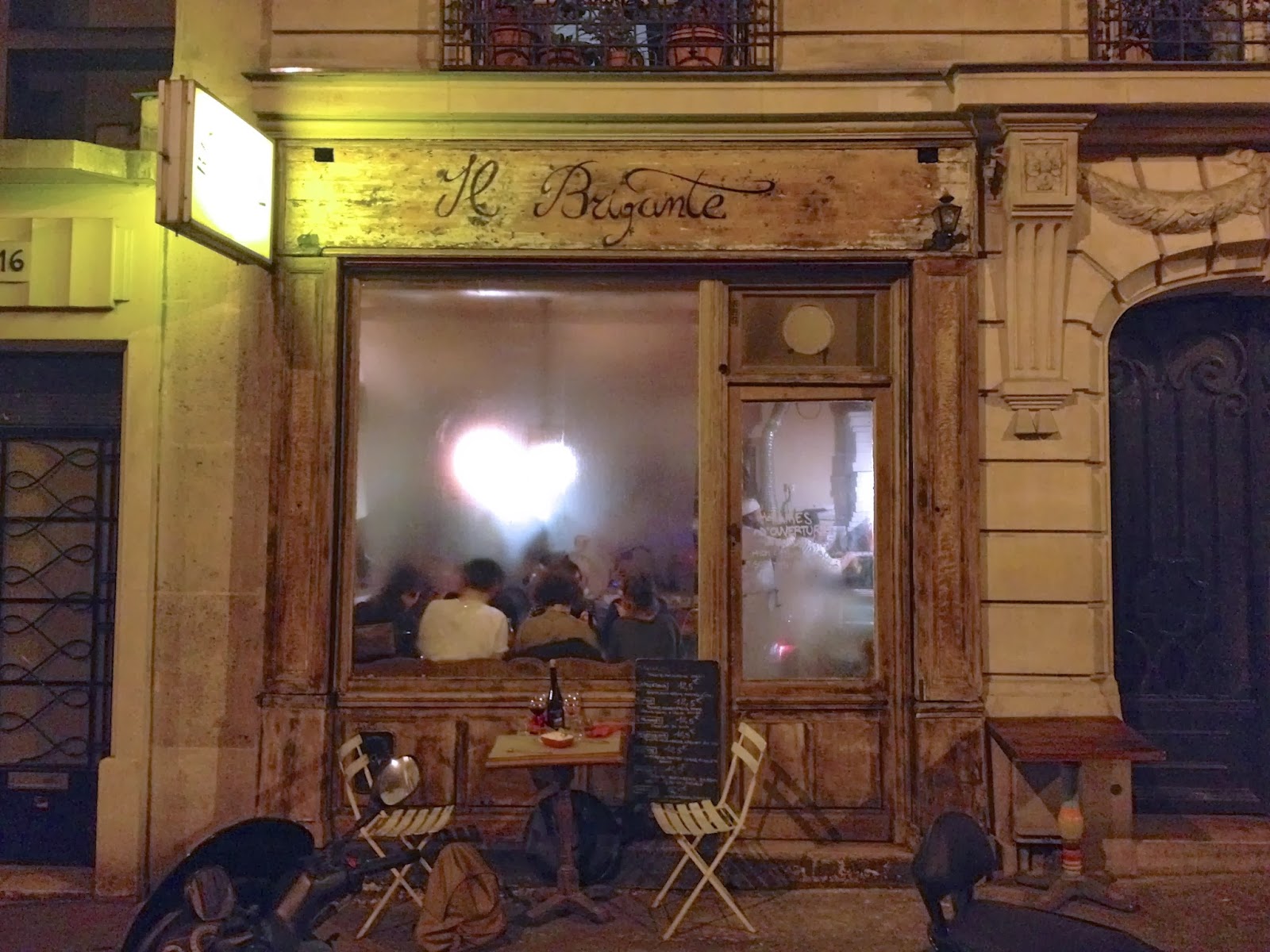
parisian pizza: il brigante, 75018


As a foreigner in Paris of a certain profusely fertile age group, I often wonder what it would be like to raise a child here. These reveries fill me with dread. One day I would wake up surrounded by an ideologically French family. It's cute when French toddlers obediently proffer their cheeks to relative strangers for goodnight kisses before toddling off to bed. It's less cute when French employees explain they took a fourth cigarette break because they needed a little pause.

And it's frankly pathetic that over half the country agrees that François Holland's right to philander with spectacularly clumsiness shouldn't be questioned by journalists. The President's recent press conference reminded me of the climactic scene from the Wizard of Oz: "Pay no attention to the man behind the curtain." (To which the obvious response is, if you want us to do that, you should begin by keeping it behind the curtain.)

But sometimes I wonder if I'm becoming indoctrinated, too. I already demand room-temp cheese and fresh bread wherever I go, which means I can't live anywhere else in the world. And a real red flag went up the other day, when at the devilishly charming Montmartre restaurant Il Brigante I genuinely enjoyed a locally popular foodstuff I've heretofore foresworn entirely: Parisian pizza.

29 January 2014

why we dine out: come a casa, 75011


I still read Pitchfork. But since it now takes less time to download albums than it does to parse reviews, I usually just peek at the point score and make the call myself. I find it's a good way to avoid the publication's increasingly boosterish take on certain handpicked darling bands, a trend that began with Deerhunter and has reached self-parodical peaks with coverage of Savages and Perfect Pussy.*

This past December, Pitchfork cited Perfect Pussy's slight 4-song demo as among the Honorable Mentions for Albums of the Year. When I played it for my friend C, a young gallerist from New Zealand, she wrinkled her nose. "Yeah Bikini Kill blah blah blah, we've heard this before." We agreed that Pitchfork was having an NME moment, a paroxysm of hyperbolic hype about something totally unproven, deriving from the writerly impulse to say things messianically.

Editors are supposed to throw cold water on that sort of thing. The task is arguably more important in food and wine journalism, since readers can't (yet) choose to simply download a meal. It always costs money and time. Quite a few Paris food writers recently had their own NME moments over a shoe-sized Tuscan restaurant by Voltaire called Come a Casa. I duly dined there and came away slightly disappointed - not by the meal, which was basically as advertised, but by Paris food writing.

25 July 2013

killing it : restaurant bones, 75011


Good or bad, a meal never quite gets replicated, because too many variables are in play. Menus change, weather shifts, vintages turn, staff move on, tables break, bars get worn, hype evaporates - and so on. In Paris, where even basic hospitality remains touchingly uncommodified, restaurants are even more protean than the norm, with the quality of a meal often coming to depend overwhelmingly on whether one's server feels chipper on a given day. A critic's challenge is to arrive at conclusions that apply to more than one experience.

The most challenging subject, therefore, is a restaurant that unceasingly challenges itself. My friend James Henry's new-ish place Bones is one of these. Tucked on a side street off métro Voltaire, the northernmost border of the culinary renaissance currently occurring in the Faidherbe-Charonne area (Septime, Le Six Paul Bert, Rino, etc.), Bones was a barnstorming success from the get-go. I could have raved about the meal I had there back in January, a tour-de-force that crested with an unforgettable dessert of fresh almonds, coffee mousse, goat yogurt sorbet, and lemon. But had I done so I couldn't have reported simultaneously on the subsequent expansion of the bar menu far beyond pulled-pork sandwiches; the restaurant's brief flirtation with à la carte service; and the flourishing of its by-the-glass list, which bests most restaurants in Paris in both breadth and quality.

I also would have missed the steady improvement in Henry's bread-making skills. He has good reason to want his bread to succeed: as Americans are to scrambled eggs, so are the French to bread, a subject on which even the dullest nitwits feel entitled to nitpick. When one sits down to dine at Bones, one is treated to a hat trick of forcefully flavourful house-made products - charcuterie, butter, and the bread - that serve as a kind of clarion, a wake-up call to any guests who, perhaps on the basis of Bones' bare décor, were expecting a simple bistrot meal.

17 June 2013

n.d.p. in florence: 5 e cinque


Florence is the only place I've ever been pickpocketed. As a friend and I snacked on one of the support columns of the Ponte Santa Trinita one evening a decade ago, some genial-seeming locals came up and spoke incomprehensibly about football maneuvers before demonstrating same at close quarters and robbing me in the process. It was all the money I had and I wound up busking the rest of that month.

As a result of this experience, I now walk down busy Florentine streets with my hands firmly placed over my back pockets, looking like some sort of constipated building inspector. Most nerve-racking for me is the famed Ponte Vecchio, a Hieronymus Boschian scene of beckoning trinket-hawkers, trilling gypsy beggars, and glass-eyed cargo-shorted tourists in visors and sweat-colored polos. The jangle of novelty key chains can be heard for miles. While revisiting the city last spring I hurried past it all in characteristic paranoiac style and waited for my friends some blocks ahead.

Imagine my surprise to discover, just a skip away from the Ponte Vecchio, the clean white storefront of 5 e Cinque, a modest, health-conscious, and well-appointed natural wine bar, the city's only one, as far as I know.

04 June 2013

n.d.p. in florence: enoteca fuori porta


It's a travel truism that the more friends one travels with, the less one sees. Monuments, museums, and moments of local colour rush past one's eyes, as though one were seeing them through a bus window... Meanwhile one seems to spend hours waiting for one another to finish up in the sodden restrooms of unremarkable cafés full of vending machines.

And when one does at last arrive a destination, the destination itself becomes the subject of debate. Should we not try some other bar ? one's friends ask. One where one of us can get a cocktail, and another can have beer, and another can have wine? None of us are ever satisfied, one's friends admit, before laughing maniacally and cartwheeling off into the Florentine night to harass strangers.

My personal destination, since arriving in Florence for a friend's wedding last spring, had been Fuori Porta, a wine bar tucked in the hills above the via di San Niccolo that a native acquaintance had recommended. I've discussed previously the extent to which the term 'wine bar' is open to interpretation, but as a rule of thumb I've found the concept is more native to Italy, where people take espresso standing, than in Paris, where beverages in general are mostly used as exuses to occupy terrace seating. And indeed, when after much cajoling I did succeed in luring my friends away to Fuori Porta to continue drinking after the wedding dinner, we weren't disappointed. It's one of those rare places where a serious wine list coexists with a free-wheeling atmosphere, where seven or eight tanked young men in rumpled suits can enjoy an impromptu mini-vertical of Castell' In Villa Chianti.

27 May 2013

n.d.p. in florence: enoteca bonatti


Florence, owing to its peerless artistic heritage of glorious renaissance treasures, is a good place to get suckered on industrial wine. Almost no one cares, however, because almost everyone is a broke study-abroad student content to drink Santa Cristina from plastic cups on apartment stoops. I'm describing myself, actually, age nineteen. I spent a month there, ostensibly studying Italian, in fact just desperately attempting to hook up with fellow students and certain of our tutors. I recommend anyone visiting Florence at age nineteen do the same.

The rest of us - including me and my reunited high school cohorts, now approaching our thirties, in town for a destination wedding - needed something decent to drink last spring.*

While I had predictably maintained no connections from my previous stay in Florence, I had in the intervening years become friendly with the native owner of a fashion boutique in the city. He didn't claim to be a wine expert, but the two recommendations he gave me both proved unimpeachable. The first was a wine shop on the refreshingly non-touristy Via Gioberti, east of the city center, called Enoteca Bonatti, where upon glancing at the shelves I instantly realised I'd need another suitcase for the trip back to Paris. Among the pearls on offer were a masterful Montalcino Rosso by Francesco Mulinari, and Abruzzese biodynamic legend Azienda Agricola Emidio Pepe's rare Cerasuolo d'Abruzzo rosé, which latter wine, I later confirmed with the winemaker's niece, is still not sold outside of Italy.

24 May 2013

the ideal : caffè dei cioppi, 75011


In the same way that many fine-dining waiters wish to be wizards whose assistants, the busser staff, do all actual plate-clearing, many restaurateurs aspire to invent Perpetual Motion Machines. It's the ideal restaurant: a motor that runs itself, free of vindictive neighbors, staff orgies, mass poisonings, or any of the other baroque malfunctions that can trip up a business and consume the sanity of its management. Ironically,  efforts to actually build Perpetual Motion Machine restaurants usually come at the expense of things like soul and hospitality and food quality. Whether we like it or not, these things won't run on inertia alone.

But I suspect there's another way to build a Perpetual Motion Machine. It's by being skilled and loving one's business and not, in fact, wishing to build a PMM as a means of absenting oneself from its daily workings.

Miniscule and modest, 11ème arrondissement Italian restaurant Caffè dei Cioppi would seem to exemplify this business model. Chef-owner Fabrizio Ferrara has for the past four years been garnering great reviews merely for offering actual serious Italian food to Parisians at fair prices, accompanied by well-chosen honest wines. The menu changes at the pace of a glacier; nothing is controversial; everything runs like a dream. The only thing more astonishing than the fact that no one else in Paris has replicated Ferrara's blueprint is that Ferrara himself has not replicated Ferrara's blueprint.

21 May 2013

the highest bidder : table de bruno verjus, 75012


A good way for a writer to earn money is to cultivate a reputation for authority on a subject rich people like. Wine and food are quite good. Things like polo, yachting, and racehorses are probably even better. All you have to do is publish a great deal on these subjects and sooner or later some organization will reward you for your apparent expertise with a sponsorship or a panel discussion or a publishing deal. Because you will have attained credibility as bait for a luxury clientele.

French food writer, blogger, cookbook author, radio personality, and now restaurateur Bruno Verjus both exemplifies and transcends this phenomenon. On the one hand, he seriously knows his stuff. His blog, FoodIntelligence, is a treasure trove of good recommendations in any price range. In his writing and in his wide-ranging interviews with chefs and artisanal food producers, Verjus evinces a passionate appreciation for, and a nuanced understanding of, the business of real food.

But Verjus is no stranger to promo work. He helps organise the Omnivore food festival. He works as an advisor to Paris auction house Artcurial and coordinated its first charity auction of gastronomic products. And with Table, his new restaurant on sleepy rue de Prague in the 12ème, he's made an ambitious play for the affections of deep-pocketed food fetishists city-wide. It's a dream restaurant for anyone who has ever cried from a balcony, "Honey, let's go bid on a wheel of 48-month parm !"

10 May 2013

ma dai ! : procopio angelo, 75010


There would not, initially, seem to be much purpose in my writing anything at all about Procopio Angelo, the eponymous restaurant of a popular Tuscan chef in Paris, once based on rue Faubourg St. Honoré, now transplanted to a back road near Colonel Fabien in the 10ème. Procopio's Italian wine list is representative of the genre as one typically encounters it in Paris: a seeming panoply of regional wines, which upon closer inspection turn out to comprise little more than the diverse ranges of a few titanic producers of supermarket wine. Then you have poor Marco Parusso's decent if overmodern Barolos - always the current vintage - sitting there like duck-decoys for the big spenders who stray in.*

But Procopio keeps cropping up in any discussion of Italian food in Paris. No less than two friends whose culinary opinions I otherwise respect have proposed his restaurant to me as an example of "real Italian."

Sociologist Peter L. Berger famously argued that reality itself is a social construction, an interwoven fabric of institutionalised social perceptions. Procopio Angelo is real Italian cuisine, if, like many Paris diners, one disregards the last twenty years' of Italian restaurateurism and continues to define Italian cuisine in opposition to the technique and complexity of a serious restaurant.

18 December 2012

hot potato: roseval, 75020


The remarkable hyperactivity of Paris food-blogging is partly due to the outsize international attention paid what is essentially a medium-sized, semi-provincial city. Thirty million tourists per year arrive in Paris; before, during, and after their vacations, they constitute a readership.

The repetitive nature of Paris food-blogging - and that of Paris dining in general - derives from limited subject matter. Restaurateurism in this medium-sized, semi-provincial city has been, for reasons both economic and societal, slow to catch up to the democratisation of gastronomy that has occurred in the past few decades. Most of the remaining first- and second-wave "bistronauts" of the 1990's and 2000's have long since settled into comfortable routines of semi-pro mediocrity; outside of hotels and Michelin-starred places, one rarely encounters service or cuisine that takes itself seriously.

This is why laudatory coverage of a few restaurants - Frenchie, Le Chateaubriand, Spring, Rino, and a few newcomers including the subject of this post, the 20ème's Roseval - will continue unabated: there stilll aren't enough informal tables whose informality does not excuse staff from evincing actual chops and ambition.* These are the tables that impress bloggers that bloggers can afford. The creative team at Roseval - chefs Michael Greenwold and Simone Tondo and sommelier Erika Biswell - formerly worked at some of these places (Le Chateaubriand, Rino, and Le Chateaubriand, respectively), and to judge by the results of their collaboration, they learned all the right moves. Roseval is the best value of its too-small category: a place where those who work outside the financial sector can experience inventive food and thrillingly obscure wines served by people who believe in what they do.

12 November 2012

n.d.p. in milan: antica trattoria della pesa


Before we caught our train down to Florence, we took a very early lunch at a restaurant one of my friends had booked, Antica Trattoria della Pesa. We were actually the ones waiting outside before the restaurant opened.

I'm not sure how often this happens at Antica Trattoria della Pesa in the springtime. It's certainly on the tourist radar, and adjacent to the train station. But the lunch on offer is midwinter-hearty Milanese fare, at dinnertime prices. It's the sort of thing that seems appropriate if a cousin has just got married, or Napoleon has just been crowned; at most other times, it's can be a bit pompous, particularly to anyone accustomed to the lively, informal style of stateside Italian restaurateurism.

That's sort of the point with this variety of restaurant, though. The hearty Milanese fare I mentioned could be spruced up and delivered a thousand times better by a more ambitious restauranteur elsewhere. Restaurants like Antica Trattoria della Pesa succeed mainly because, being institutions, they evince no ambition. From the perspective of a certain conservative diner, ambition is the last thing one would want to perceive in a meal, and would be avoided at the sacrifice of almost any other criterion for a good meal, except high cost.

11 October 2012

n.d.p. in milan: il kiosko


My visit to Milan this past spring was so cursory that it should not reflect poorly upon the city's dining scene if I say that my best meal there occurred on a traffic island.

Il Kiosko is what it says it is: a kiosk selling fish in the Piazza XXIV Maggio. In addition to supplying home chefs, Il Kiosko serves fritto misto and crudo fresh from the riviera to the aperitivo crowd around the canals. There are high tables, and benches if you arrive early enough. If you can ignore the car exhaust, it's a very inviting place to snack.

I'd suggest the car exhaust even adds something - an enlivening contrast to the sterile environments in which one customarily consumes raw fish. I can report that my friend M and I definitely felt like righteous urban pre-Prometheans, standing there on the curbside, tearing into the raw slivers we'd just seen nicked from the belly of the whole damn fish.

09 October 2012

n.d.p. in milan: peck


As I poked around Peck I tried to take a couple pics. Got scolded. Apparently Peck - an historical Milanese fine food emporium - is as famous for its image control as it is for its vast stores of wine, olive oil, and ham.

It's a little baffling. Peck has neither the design elements nor the security risks that might warrant overzealous image control. It's a fine food shop, not a museum, not an embassy. Some fine food shops fulfill a quasi-ambassadorial role, it's true: think Turin's Eataly. But in comparison to the grandiosity and festival atmosphere of that place, Peck seemed a bit quaint, even at 3500m2 over three floors. The short young clerk who instructed me not to take pictures had been the same one who'd shadowed me as I perused the wine racks of Peck's basement level, offering little in the way of advice.

This happened to suit me fine, as I didn't need any. We had 20 minutes to kill in central Milan after lunch, and my friends M and V kindly indulged my desire to spend it all perusing shelves of Italian wine classics. In retrospect this may have been a mistake, since it meant that during our perambulations throughout the city later that day I was burdened with numerous cult-status bottles I'd been unable to resist.