13 May 2013

good works: l'épicerie du 104, 75019


The Native Companion has lately succeeded in dragging me to more museums. Each time in the ticket line I confront my reason for usually staying home : a bedraggled queue of hat-haired tourists with their hands full of waffles and soda, whacking me with their overstuffed backbacks. Public art ! But we were lucky the other day on our visit to the Keith Haring exhibition presently on view at Le 104, the 19ème arrondissement's echoing, perpetually under-filled municipal art space. We arrived just before the afternoon rush and took in Haring's brilliant, trumpeting tarpaulin work in relative peace, before we departed to our respective workplaces.

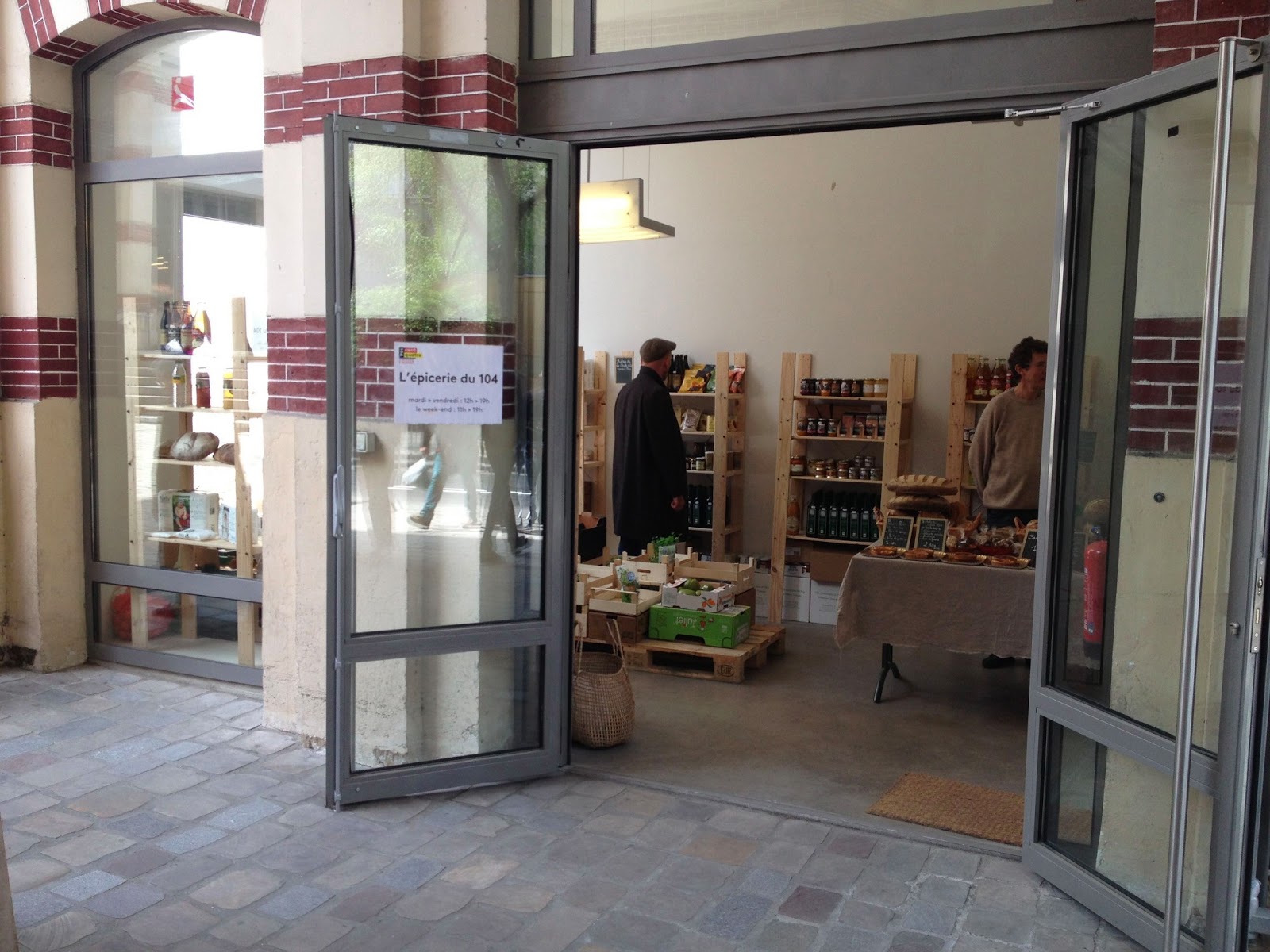
On my way out, I noticed that a little épicerie bio had opened right by the glass doors of Le 104's rue Curial entrance, in a space resembling one of those tollbooths lodged in support columns. I popped my head in and was delighted to discover a slim, affordable selection of natural wines on offer, including, among others, Saone organic vigneron Guy Bussière's marvelous flinty Melon de Bourgogne cuvée, "Phénix."

L'Epicerie du 104 opened February 2nd, I learned. Our late-coming, tentative springtime this year means that the shop is only just now attaining relevance as a perfect pit-stop before a visit to Le 104's exhibit and a picnic in the Jardin d'Eole, the overlooked strip of public greenery wedged between Le 104 and the twisting river of train tracks leading to Gare de l'Est.

10 May 2013

ma dai ! : procopio angelo, 75010


There would not, initially, seem to be much purpose in my writing anything at all about Procopio Angelo, the eponymous restaurant of a popular Tuscan chef in Paris, once based on rue Faubourg St. Honoré, now transplanted to a back road near Colonel Fabien in the 10ème. Procopio's Italian wine list is representative of the genre as one typically encounters it in Paris: a seeming panoply of regional wines, which upon closer inspection turn out to comprise little more than the diverse ranges of a few titanic producers of supermarket wine. Then you have poor Marco Parusso's decent if overmodern Barolos - always the current vintage - sitting there like duck-decoys for the big spenders who stray in.*

But Procopio keeps cropping up in any discussion of Italian food in Paris. No less than two friends whose culinary opinions I otherwise respect have proposed his restaurant to me as an example of "real Italian."

Sociologist Peter L. Berger famously argued that reality itself is a social construction, an interwoven fabric of institutionalised social perceptions. Procopio Angelo is real Italian cuisine, if, like many Paris diners, one disregards the last twenty years' of Italian restaurateurism and continues to define Italian cuisine in opposition to the technique and complexity of a serious restaurant.

06 May 2013

why ask why: la pulperia, 75011


Natural wine enthusiasts are kind of like vegetarians: we know their preferences, but their reasons why diverge wildly. A few natural wine fans are taking an ecological stand. (It stands to reason that most natural wine restaurants in Paris serve sustainable fish.) Other people just want to avoid headaches. Still others - and in this category I would place most of the vignerons I know - have only aesthetics in mind: they promote natural wine because it simply tastes better.

My own reasons for preferring natural wine are complicated, half-aesthetic, quasi-Marxist, cultural preservationist... I can't choose just one. But it seems to me that one would have to be firmly in the pure-aesthetics camp in order to justify serving natural wine beside steaks shipped from Argentina, as chef Fernando de Tomaso does at his 11ème Argentine bistrot La Pulperia.

The practice also identifies the restaurant as being aimed at squarely at native Parisians. Anyone else - all the expats I know and surely every tourist - would prefer, whilst in Paris, to consume any of the numerous renowned varieties of French beef (Charolais, Aubrac, etc.). Many of us have stood by shaking our heads as international meat places like Bang!, The Beef Club, and La Pulperia open, and French restaurant culture sails further into the maw of the global capitalist whale, the belly of which contains everything, as many choices as a Whole Foods Market... Doomsaying aside, La Pulperia boasts pleasing cuisine and a surprisingly deep natural wine list, making it a probably a fine place to return if I ever become truly Parisian. (God help me.)

02 May 2013

another (excellent) restaurant : le six paul bert, 75011


Some time after we stopped dating, my ex F moved to a really superb apartment just next to one of Paris' most beloved bistrots and steak-frites destinations, Bistrot Paul Bert. I can be sure she did this purely to make me jealous, because she herself is vegetarian.

Despite this hurdle, we've managed to remain good friends. So back in January it was a tip-off from F that hipped me to the opening of Bistrot PB proprietor Bertrand Auboyneau's then-new place, Le Six Paul Bert, a small-plates spin-off just down the road from the motherships. (Auboyneau also has PB's adjacent seafood restaurant, L'Ecailler du Bistrot.) Initial rumours had given me to believe the new place was to be a wine bar - and the mere idea of a wine bar by the maestro behind Bistrot Paul Bert filled me with a kind of dread and awe, imagining how unbeatably great such an undertaking would be.

But the rumours turned out to be rumours. Leaving aside its functions as an épicerie and its speakeasy-style name, Le Six Paul Bert is Another (Excellent) Restaurant, albeit one that adopts some of the trappings of small-plates wine bars. The effect is to inadvertently highlight, for anyone who may have believed otherwise, how alien the idea of a new world-style wine bar is to Paris.

29 April 2013

despite the name: la pointe du groin, 75010


I might as well start off by explaining that La Pointe du Groin is an alternate spelling for La Pointe du Grouin, a rocky outcropping on the bay of Mont Saint Michel in Brittany. It's also where renowned chef-restaurateur Thierry Breton hails from. Breton, like many of his countrymen, enjoys a good meaningless pun. For his multifarious, rather groundbreaking new wine bar project, Breton has chosen the emblem of a grinning pig - for in French, groin means the snout, and not some other part of pig anatomy.

One may nonetheless presume that the English signification is not entirely lost on Breton. The bar's name is just one of several baffling features of the project, which include, but are not limited to, outlandishly bad décor and an incomprehensible payment scheme in which guests will be expected to exchange their euros for fake money - Groin coins ? - accepted only at La Pointe du Groin.

Despite these obstacles, La Pointe du Groin is primed for succcess. It's spacious, rangey, and weird, offering magnums of natural wine and simple small plates at a price-quality ratio approaching the one achieved when Manhattan was bought for beads. It's a Paris wine bar that explodes the traditional Parisian opposition between egalité and haute-qualité: a place where many can drink well for very little.

22 April 2013

the great american sandwich: verjus, 75001


The other day at lunchtime my colleague R and I announced to our high-pitched and highly amusing senior colleague L that we were going out to get sandwiches. As is her wont, she asked us to pick up one for her. I said no problem, I'd text her a pic of the menu.

No no no, she said, just get me jambon à l'os, with cantal...

At which point I was obliged to explain we were not going to any old interchangeable French sandwich place. R and I were going to Restaurant Verjus*, whose newly launched lunchtime sandwich program is essentially a Great American Road Trip of sandwich nostalgia. There's a slim menu of sandwiches, each named after its culinary inspiration: a pork belly homage to Momofuku's David Chang, fried chicken ode to Bakesale Betty in Oakland... It's like owners Braden Perkins and Laura Adrian wanted to adapt the Proustian madeleine to the American palate, and give their numerous expat fans something to make their hearts melt and their mouths water.

18 April 2013

beyond compare : le mary celeste, 75003


Most comparisons of cities are offered as a way for the speaker - usually an inhabitant of the smaller or less lively of the two cities being compared - to make a display of worldliness and, in doing so, reassure him or herself of the wisdom of winding up in the smaller or less lively city. It's a human phenomenon, as common in Paris as in Boston and San Diego. One also hears it constantly from any New Yorker who has ever chosen to settle elsewhere.*

But, as Italo Calvino hints in his book Invisible Cities, in which narrator Marco Polo describes a seeming infinity of exotic metropolises that all turn out to be Venice, cities might more accurately be considered closed system unto themselves, incomprehensible to outsiders. Narrator Marco Polo's descriptions exceed the imagination his interpellator Kublai Khan, and indeed of the reader. It's impossible to accurately judge one city by the scale of another.

So far, the greatest benefit I've derived from this way of thinking is that it has permitted me to love Le Mary Celeste, an oyster bar some good friends recently opened in the Marais.

14 April 2013

not dead


I'm still alive. As of now I still intend to continue the blog. I'm sort of husbanding writerly resources at the moment, sketching out drafts of what might one day (if I'm lucky) become a Not Drinking Poison In Paris book.

Not a Paris guide book, nor a comprehensive fact-driven wine book. Some other kind of book. That's my elevator pitch.

There's also been a bit of travel. To my embarrassingly long list of trips awaiting thorough blog coverage - Florence, Bordeaux, Hydra, Bilbao, Avize, Troyes, London, New York, Los Angeles - I can now add Tokyo, where the other evening at a stand near Ometesando station a colleague introduced me to takoyaki, or octopus balls.

11 January 2013

small victories : septime cave, 75011


Septime le resto, its relative informality notwithstanding, is a destination restaurant. One needs to plan ahead - not to mention budget, both time and money - to enter its almost-too-well-appointed walls and enjoy chef-owner Bertrand Grébaut's acclaimed market menu, which at dinner is offered only as a 55€ (before wine) "carte blanche" meal of at least five courses. One can't resent any of this: these are the hassles that attend high demand, and they're to be expected at any restaurant whose excellence is a match for its ambition.

But the resplendent success of Septime makes all the more laudable that Grébaut's new project, a wine bar-slash-wine shop catty-corner to the restaurant, is basically a shanty stocked with wine and some meat. It is heroically under-conceived. If Septime is the mothership, exerting a gravitational pull on diners citywide, Septime Cave is the dinghy : a little escape pod for tasteful rue de Charonne locals seeking a random weeknight tipple.

31 December 2012

call it a caviste: la buvette, 75011


In a break from my habit of writing about things long after they've lost all relevance, I thought I'd mention my friend Camille Fourmont's brand new caviste-slash-bar à vin, La Buvette, which opened for business on rue Saint Maur in the 11ème a little over a week ago.

I hadn't seen Camille in a while, and hadn't been aware she'd left her former gig, as bar manager of  Inaki Aizpitarte's overdesigned wine bar Le Dauphin. I just happened to be walking by on an errand the other day, when a Julien Courtois wine label in her sparse window display caught my attention.

It's a surprise to see such a cult wine on that stretch of road, which is otherwise dominated by superettes and timewarpy little do-nothing bistrots that seem to survive, like lichen, on air alone. It's also a surprise to peer in the windows and see - good lord ! - a trim, contemporary establishment, where good taste is as perceptible in the décor as it is in the mostly-natural wine selection. There's clean white tiling, and simple tables and chairs, and, mostly importantly for my purposes, a solid and inviting zinc-capped bar.

18 December 2012

hot potato: roseval, 75020


The remarkable hyperactivity of Paris food-blogging is partly due to the outsize international attention paid what is essentially a medium-sized, semi-provincial city. Thirty million tourists per year arrive in Paris; before, during, and after their vacations, they constitute a readership.

The repetitive nature of Paris food-blogging - and that of Paris dining in general - derives from limited subject matter. Restaurateurism in this medium-sized, semi-provincial city has been, for reasons both economic and societal, slow to catch up to the democratisation of gastronomy that has occurred in the past few decades. Most of the remaining first- and second-wave "bistronauts" of the 1990's and 2000's have long since settled into comfortable routines of semi-pro mediocrity; outside of hotels and Michelin-starred places, one rarely encounters service or cuisine that takes itself seriously.

This is why laudatory coverage of a few restaurants - Frenchie, Le Chateaubriand, Spring, Rino, and a few newcomers including the subject of this post, the 20ème's Roseval - will continue unabated: there stilll aren't enough informal tables whose informality does not excuse staff from evincing actual chops and ambition.* These are the tables that impress bloggers that bloggers can afford. The creative team at Roseval - chefs Michael Greenwold and Simone Tondo and sommelier Erika Biswell - formerly worked at some of these places (Le Chateaubriand, Rino, and Le Chateaubriand, respectively), and to judge by the results of their collaboration, they learned all the right moves. Roseval is the best value of its too-small category: a place where those who work outside the financial sector can experience inventive food and thrillingly obscure wines served by people who believe in what they do.

11 December 2012

planet of women : l'auberge flora, 75011


One would like to cite beauty, good taste, and pleasure as one's dining ideals. But, as in most fields, there are extra-aesthetic concerns. One has to rate establishments according to the scope of their ambition, and according to the service they provide in a given community.

By the latter standard, Bastille-quartier chambre d'hôte L'Auberge Flora is a certain kind of paradise, appearing like an oasis on an otherwise creepy and barren strip of road just east of the Marais. It's the new project of a veteran Paris chef called Florence Mikula, whose previous restaurants, judging by early reviews of L'Auberge Flora, permanently endeared her to a certain generation of Paris food writers. Several elements of the new restaurant are expertly in place, or nearly so: the staff (all ladies, when I visited) are warm and considerate, and a meal is fairly priced, given it's a hotel. What the byzantine menu of tapas lacks in precision or focus it makes up for in sheer novelty. (How nice, once in a while in Paris, not to consume a hunk of meat for dinner.)

But dear god, the décor. It's like getting nuzzled by a unicorn, and waking up surrounded by twittering birds beneath a rainbow on a cotton candy cloud floating magically above a Land Without Men, where wine lists are delivered with butterfly hairclips holding the pages together. (I am not kidding.)

07 December 2012

a village called paris : cave fervèré, 75011


One indication I've been doing this blog too long is that certain restaurants and wine bars I've written about have since been sold, or closed down, or been completely revamped. When I last mentioned my restaurateur friend Olivier Aubert, he had, in the space of about a year, opened three restaurants: La Bodeguita du IVeme, la Bodeguita du IXeme, and Les Trois Seaux in the 11ème.

Aubert is presently selling La Bodeguita du IVeme, having shed the weirdly-shaped and generally unsuccessful la Bodeguita du IXeme long ago. Les Trois Seaux is still operational, still a solid wine bistrot where the respectable food and service are undercut by clumsy décor and a silly name. ("The Three Buckets." I have never understood why they use white tablecloths in a space like that.)

Now on rue des Trois Bornes, one street away from Les Trois Seaux, Aubert is at it again: he's opened a pichet-sized wine bistrot called Cave Fervèré, its name a reference to the iron grillwork on the windows. It's another two-man operation, just him and a chef, with a slim menu of provincial staples, and a shelf of solid natural wines at generous prices. What's to get excited about? you might ask. Why follow Aubert's bantering roadshow of openings and closures to yet another address? Because Aubert's restaurants, in their simplicity and utter lack of pretense, represent all that's best about living in Paris, which is to say they feel like the countryside. Also, he is serving a really killer andouillette right now.

28 November 2012

unpolished: miroir, 75018


The fashion company I work for used to have a shop not far from métro Abbesses in Montmartre. I think the original commercial rationale was: it's a picturesque neighborhood, with a lot roving tourists - surely they'll purchase accessories ?

The shop didn't work for several reasons. To put it simply, the neighborhood wasn't 'there,' yet; nor, with the constant influx of panting tourists looking for the Amelie café, was it clear it would ever get 'there.' All the knick-knackery shuts out higher-end retail. Tourists hiking towards Sacre Coeur, if they did stop to shop, did so in places that looked scruffier or more classically Montmartrois than our brand. (Paris tourists generally seek either the mythical cosmopolitan Paris or the mythical village Paris. The city's actual charm is that it contains both myths, often simultaneously, on the same street - but tourists in Montmartre are hunting for the latter one.)

I am getting around to discussing a neighborhood restaurant - Miroir, also located quite near Abbesses. I visited during Fashion Week in October on the recommendation of my favorite lunch purveyor and wine aficionado Balthazar de la Borde. On the one hand, I agree with Balt that Miroir is a godsend, given its location: an unfussy place to get a tasty and well-sourced, mostly-traditional meal, replete with a good, mostly-natural wine list. (The proprietors of Miroir also run the Cave de Miroir across the street.) On the other hand, I suspect that Miroir, like the neighborhood, is not 'there' yet, and on the night we dined there, one major service bungle made me despair of it ever getting 'there.'

12 November 2012

n.d.p. in milan: antica trattoria della pesa


Before we caught our train down to Florence, we took a very early lunch at a restaurant one of my friends had booked, Antica Trattoria della Pesa. We were actually the ones waiting outside before the restaurant opened.

I'm not sure how often this happens at Antica Trattoria della Pesa in the springtime. It's certainly on the tourist radar, and adjacent to the train station. But the lunch on offer is midwinter-hearty Milanese fare, at dinnertime prices. It's the sort of thing that seems appropriate if a cousin has just got married, or Napoleon has just been crowned; at most other times, it's can be a bit pompous, particularly to anyone accustomed to the lively, informal style of stateside Italian restaurateurism.

That's sort of the point with this variety of restaurant, though. The hearty Milanese fare I mentioned could be spruced up and delivered a thousand times better by a more ambitious restauranteur elsewhere. Restaurants like Antica Trattoria della Pesa succeed mainly because, being institutions, they evince no ambition. From the perspective of a certain conservative diner, ambition is the last thing one would want to perceive in a meal, and would be avoided at the sacrifice of almost any other criterion for a good meal, except high cost.

24 October 2012

n.d.p. in milan: bar basso


Seeking to wring every last drink out of my brief stay in Milan, I arranged to meet my friend and host M for last call at Bar Basso, a proudly classic, slightly hokey cocktail bar famous for being the birthplace of possibly my favorite cocktail, the Negroni Sbagliato, or wrong Negroni.

The Negroni Sbagliato is simply a Negroni made with prosecco instead of gin. Just Campari, dry vermouth, and prosecco. I was introduced to the drink just a few years ago at a restaurant called Dell'Anima in the West Village, whose proprietor Joe Campanale has had great success with a variation involving roasted orange.

The cocktail's genesis story - all successful cocktails have at least one - is that Bar Basso's proprietor's father was mixing a Negroni and grabbed the wrong bottle, presumably realising his error when the ostensible gin bubbled and fizzed. The cocktail thus born is buoyant, bitter, immensely refreshing, and notably less inebriating than a classic Negroni, therefore ideally suited to endless aperitivo hours. It's also completely idiot-proof, with the exception of one time in Paris when I received it in a piddling frouffy champagne flute, which seemed gravely wrong at the time. Then again, before visiting Bar Basso and seeing how a Negroni Sbagliato was served by its originators, how was I to know ?