31 July 2013

hey one-percenter : le griffonnier, 75008


Hey, One-Percenter ! Ever wished to enjoy a simple French bistrot experience, only significantly nicer, at marginally greater cost ?

Haven't we all. I'm barely solvent, and still I routinely find myself wishing I could simply pay more for a civil experience in Paris. There's a cultural chasm in contemporary French restaurateurism, between the segment that whorishly lunges after money and modernity, and the rest, to whom the very idea of money is vaguely offensive, like a horse suggesting horse-riding to other horses.

The great thing about 8ème arrondissement power-bistrot Le Griffonnier is it's the sort of establishment one thinks must exist, and turns out, in fact, to exist : a place where politicians and bankers eat the same unimprovable French village staples as you do for lunch every day, only their plates arrive with a glistening side of wealth, by which I mean serious service and serious wine.

29 July 2013

lettie teague nearly encounters natural wine, remains skeptical


Vis à vis this howler of an article published earlier this month by Wall Street Journal wine critic Lettie Teague, I'm like the medieval juror who shows up late to court only to find the guilty defendant has already been executed. My work here seems to be done.

Teague's article was so journalistically bankrupt, however, and betrayed such an objectionable misunderstanding of the subject of wine in general, that I thought I might blow on the embers around the stake a bit before I return to my day job.

My few French readers might quite like my chief criticism : that Lettie Teague passed public judgment on an arguably French phenomenon without quoting any French people whatsoever. It's like asking Europeans to define barbecue, or brunch. The sources she quoted (full list presented in all its absurdity after the jump) seem to have been chosen at random, or perhaps in the course of research for unrelated articles. Teague's conclusion, after sampling no self-identified natural wines and speaking to precisely one person with more than a peripheral relationship to the scene (Alice Feiring), is that some wines considered natural taste good, others don't, but she doesn't want to hear about it either way. She just wants a nice beverage.

25 July 2013

killing it : restaurant bones, 75011


Good or bad, a meal never quite gets replicated, because too many variables are in play. Menus change, weather shifts, vintages turn, staff move on, tables break, bars get worn, hype evaporates - and so on. In Paris, where even basic hospitality remains touchingly uncommodified, restaurants are even more protean than the norm, with the quality of a meal often coming to depend overwhelmingly on whether one's server feels chipper on a given day. A critic's challenge is to arrive at conclusions that apply to more than one experience.

The most challenging subject, therefore, is a restaurant that unceasingly challenges itself. My friend James Henry's new-ish place Bones is one of these. Tucked on a side street off métro Voltaire, the northernmost border of the culinary renaissance currently occurring in the Faidherbe-Charonne area (Septime, Le Six Paul Bert, Rino, etc.), Bones was a barnstorming success from the get-go. I could have raved about the meal I had there back in January, a tour-de-force that crested with an unforgettable dessert of fresh almonds, coffee mousse, goat yogurt sorbet, and lemon. But had I done so I couldn't have reported simultaneously on the subsequent expansion of the bar menu far beyond pulled-pork sandwiches; the restaurant's brief flirtation with à la carte service; and the flourishing of its by-the-glass list, which bests most restaurants in Paris in both breadth and quality.

I also would have missed the steady improvement in Henry's bread-making skills. He has good reason to want his bread to succeed: as Americans are to scrambled eggs, so are the French to bread, a subject on which even the dullest nitwits feel entitled to nitpick. When one sits down to dine at Bones, one is treated to a hat trick of forcefully flavourful house-made products - charcuterie, butter, and the bread - that serve as a kind of clarion, a wake-up call to any guests who, perhaps on the basis of Bones' bare décor, were expecting a simple bistrot meal.

11 July 2013

the home front : touller outillage, 75011


As preamble to what I'm about to say about new 11ème wine bar Touller Outillage, I thought I'd introduce readers to its surrounding Parmentier neighborhood, where I've been living for the past four years. 

Two parallel roads descend southwest from Menilmontant, one of which, rue Oberkampf, I've previously described as "a waterslide of vomit" until it hits métro Parmentier. There are student bars, concert venues, dire nightclubs, and leery downmarket bistrots straight out of a Jeunet film. The other road, rue Jean Pierre Timbaud, is first occupied by a mosque and the related Islamo-paraphernalia industry, arrayed around a dusty pigeon-painted public square; but southwest of this pious interlude the road resumes the habits of its neighbor and becomes a debaucherous slag-heap of strong beer and kebabs. Bisecting these two roads is rue Saint Maur, a nice enough road further south-east, but one which along this particular stretch houses both a miniature skee-ball hall and a deserted bar themed around race-car simulators.  

When diners, both Parisian and international, complain, with certain justification, that natural wine has become a trendy luxury, they are most certainly not referring to my neighborhood or my street. Which is why I take it as a salutary development - a sign that natural wine is reaching new audiences - when Said Messous, owner of Jean Pierre Timbaud nightclub L'Alimentation Generale, reveals himself to be a closet natural wine fan, and helps his cousin Farid Meza open a roomy, egalitarian, helplessly unhip wine bar like Touller Outillage right next door.  

05 July 2013

paris wine company launch


My good friend and frequent travel companion Josh Adler is launching a company that ships wine from France to private clients the USA. He's called it Paris Wine Company, a name I initially hated but which has grown on me slightly since. Unbelievably, the domaine name wasn't already taken, possibly having been passed over as too faceless or ill-targeted. (Pets dot com, anyone?)

Parisians sure won't be buying much wine from him. Parisians by and large don't spend any serious money on wine, and the few that do don't seem to purchase from anyone they haven't known for generations. Josh will mainly be shipping to our fellow Americans, in an importer-distributor-wineseller circumvention that has already teed off several other industry friends. What's good news for private wine clients, these industry friends argue, is bad news for them and the industry they serve.

I can see both sides of the argument. I delve into them after the jump. But the occasion for this post wasn't soul-searching on my part. It was to mention - all philosophical qualms ceding precedence to friendship - that Paris Wine Company is launching tomorrow, July 6th, with a tasting / party at Verjus Wine Bar (75001) at 2pm, featuring superb Angevin vignerons Nicolas Bertin & Genevieve Delatte and Kenji & Mai Hodgson.

01 July 2013

the angevin clan, pt. 3: bertin-delatte / l'echalier, rablay-sur-layon


In writing about the generation of young Anjou vignerons I've come to call the Angevin Clan, my chronology has inadvertently worked against central figures Nicolas Bertin and Geneviève Delatte of Domaine Bertin-Delatte.  They're the last of the clan to be discussed, when in fact it was Delatte who introduced my friends and me to Cédric Garreau, and it was at Bertin and Delatte's unfinished house that we all gathered for lunch after tasting with Garreau and Kenji and Mai Hodgson.

Having founded their 3ha estate in 2008, Bertin and Delatte have a few years more experience than the other vignerons at the lunch table that day. But Bertin only gave up his part-time job tending vines for nearby estate Domaine Pierre Chauvin the week before we visited. (Cedric Garreau, for his part, still does vineyard work for other estates to make ends meet.) Bertin may have encapsulated the challenges facing a young vigneron in the Coteaux de Layon when we asked him whether he'd ever tried his hand at making the region's eponymous sweet wine: No, he said, because he doesn't like drinking it, it's hard to make, and it's hard to sell.

Bertin and Delatte make just one wine in any appreciable quantity: L'Echalier, a mostly young-vine dry Chenin that, I was to realise over lunch that day, I had always been drinking too young. Can I be blamed ? It's what one usually does with young-vine Chenin in that price point. How was I to know, before meeting and tasting with the winemakers, that "L'Echalier" positively blooms in the bottle after two years?

26 June 2013

the angevin clan, pt. 2: cédric garreau / gar'o'vins, chanzeaux


The evening before our visits with newly-installed Anjou vigneron Cédric Garreau and the rest of the Angevin clan back in January, my friends J, M, and I found ourselves at Angers natural wine bar Le Cercle Rouge, sharing a nightcap with some US importers with whom J and M were discussing working. It was during the time of La Dive Bouteille, La Renaissance des Appellations, and the various satellite tastings, and we'd assumed we'd run into a few vignerons and fellow industry folk at La Cercle Rouge that night. But we'd evidently missed a memo, because the place was quiet as the grave. If I concentrated, I imagined I could actually hear echoes from the wild bacchanal in the surrounding hills where all the vignerons and the more clued-in buyers were probably spraying each other with pétillant naturel and doing impressions of Americans.

If we nevertheless stayed at Le Cercle Rouge for the duration of two bottles, it was because the wine we were drinking - Cédric Garreau's 2011 "Le Lulu Berlue" - achieved the almost impossible : it was marvelously palatable to five weary palates that had endured a sequence of professional tastings earlier in the day. (Ordinarily such circumstances are the only moments in life where one craves Kronenberg.)

The "Lulu Berlue" is an odd duck, a sparkling carbonic-maceration Cabernet Sauvignon, mouth-rinsing, pure, and black-fruited, sort of like fine Loire Lambrusco. It hit the spot. The next day when we visited Garreau's tiny shed of a cellar in Chanzeaux we were able to confirm that all his red wines - all three - share the same soulful purity of fruit that made the "Le Lulu Berlue" so entrancing. They're wines that feel fundamentally healthful, and they herald a new voice in Angevin winemaking, one whose maturity of expression is surprising given its only Garreau's second vintage.

24 June 2013

the angevin clan, pt. 1: mai and kenji hodgson / vins hodgson, rablay-sur-layon

From L: Kenji Hodgson, Cedric Garreau, M, Mai Sato, Nicolas Bertin, J. Taken in Bertin's vineyards.

After departing from La Dive Bouteille this past January, my friends J, M, and I went to visit a few newly-installed Angevin vignerons. We'd planned to make separate appointments with three domaines - Mai & Kenji Hodgson, Cedric Garreau / Gar'O'Vin, and Bertin-Delatte - but upon learning that their proprietors are all good friends and collaborators, it was decided we'd all taste together at each cellar and then have lunch. 

For J, M, and I, tasting at the three domaines that morning was revelatory. It might have just been an on-palate day.* But after just about every taste, we were having "On First Looking Into Chapman's Homer" moments, looking at each other, like Cortez's sailors, "with a wild surmise." 

All of these vignerons are onto something. All are members of a collective of organic Angevin vignerons who organise tastings together, loan each other equipment, and generally support one another in the daunting task of making and selling quality wine from Anjou, a famously schizophrenic region, nigh-on uncategorizeable, home to everything from industrial Cab Franc rosé to ageless Quarts de Chaume. The collective officially call themselves "The En Joue Connection," which has facetious gangster-ish implications that I will relegate to a footnote.* I can't speak for the entire collective, because I haven't tasted all the wines. But with regards to Bertin-Delatte, Vins Hodgson, and Gar'O'Vins, I thought it might be more helpful to think of what they're presently achieving in Anjou in terms of some other poets, namely the Wu-Tang Clan.  

17 June 2013

n.d.p. in florence: 5 e cinque


Florence is the only place I've ever been pickpocketed. As a friend and I snacked on one of the support columns of the Ponte Santa Trinita one evening a decade ago, some genial-seeming locals came up and spoke incomprehensibly about football maneuvers before demonstrating same at close quarters and robbing me in the process. It was all the money I had and I wound up busking the rest of that month.

As a result of this experience, I now walk down busy Florentine streets with my hands firmly placed over my back pockets, looking like some sort of constipated building inspector. Most nerve-racking for me is the famed Ponte Vecchio, a Hieronymus Boschian scene of beckoning trinket-hawkers, trilling gypsy beggars, and glass-eyed cargo-shorted tourists in visors and sweat-colored polos. The jangle of novelty key chains can be heard for miles. While revisiting the city last spring I hurried past it all in characteristic paranoiac style and waited for my friends some blocks ahead.

Imagine my surprise to discover, just a skip away from the Ponte Vecchio, the clean white storefront of 5 e Cinque, a modest, health-conscious, and well-appointed natural wine bar, the city's only one, as far as I know.

04 June 2013

n.d.p. in florence: enoteca fuori porta


It's a travel truism that the more friends one travels with, the less one sees. Monuments, museums, and moments of local colour rush past one's eyes, as though one were seeing them through a bus window... Meanwhile one seems to spend hours waiting for one another to finish up in the sodden restrooms of unremarkable cafés full of vending machines.

And when one does at last arrive a destination, the destination itself becomes the subject of debate. Should we not try some other bar ? one's friends ask. One where one of us can get a cocktail, and another can have beer, and another can have wine? None of us are ever satisfied, one's friends admit, before laughing maniacally and cartwheeling off into the Florentine night to harass strangers.

My personal destination, since arriving in Florence for a friend's wedding last spring, had been Fuori Porta, a wine bar tucked in the hills above the via di San Niccolo that a native acquaintance had recommended. I've discussed previously the extent to which the term 'wine bar' is open to interpretation, but as a rule of thumb I've found the concept is more native to Italy, where people take espresso standing, than in Paris, where beverages in general are mostly used as exuses to occupy terrace seating. And indeed, when after much cajoling I did succeed in luring my friends away to Fuori Porta to continue drinking after the wedding dinner, we weren't disappointed. It's one of those rare places where a serious wine list coexists with a free-wheeling atmosphere, where seven or eight tanked young men in rumpled suits can enjoy an impromptu mini-vertical of Castell' In Villa Chianti.

27 May 2013

n.d.p. in florence: enoteca bonatti


Florence, owing to its peerless artistic heritage of glorious renaissance treasures, is a good place to get suckered on industrial wine. Almost no one cares, however, because almost everyone is a broke study-abroad student content to drink Santa Cristina from plastic cups on apartment stoops. I'm describing myself, actually, age nineteen. I spent a month there, ostensibly studying Italian, in fact just desperately attempting to hook up with fellow students and certain of our tutors. I recommend anyone visiting Florence at age nineteen do the same.

The rest of us - including me and my reunited high school cohorts, now approaching our thirties, in town for a destination wedding - needed something decent to drink last spring.*

While I had predictably maintained no connections from my previous stay in Florence, I had in the intervening years become friendly with the native owner of a fashion boutique in the city. He didn't claim to be a wine expert, but the two recommendations he gave me both proved unimpeachable. The first was a wine shop on the refreshingly non-touristy Via Gioberti, east of the city center, called Enoteca Bonatti, where upon glancing at the shelves I instantly realised I'd need another suitcase for the trip back to Paris. Among the pearls on offer were a masterful Montalcino Rosso by Francesco Mulinari, and Abruzzese biodynamic legend Azienda Agricola Emidio Pepe's rare Cerasuolo d'Abruzzo rosé, which latter wine, I later confirmed with the winemaker's niece, is still not sold outside of Italy.

24 May 2013

the ideal : caffè dei cioppi, 75011


In the same way that many fine-dining waiters wish to be wizards whose assistants, the busser staff, do all actual plate-clearing, many restaurateurs aspire to invent Perpetual Motion Machines. It's the ideal restaurant: a motor that runs itself, free of vindictive neighbors, staff orgies, mass poisonings, or any of the other baroque malfunctions that can trip up a business and consume the sanity of its management. Ironically,  efforts to actually build Perpetual Motion Machine restaurants usually come at the expense of things like soul and hospitality and food quality. Whether we like it or not, these things won't run on inertia alone.

But I suspect there's another way to build a Perpetual Motion Machine. It's by being skilled and loving one's business and not, in fact, wishing to build a PMM as a means of absenting oneself from its daily workings.

Miniscule and modest, 11ème arrondissement Italian restaurant Caffè dei Cioppi would seem to exemplify this business model. Chef-owner Fabrizio Ferrara has for the past four years been garnering great reviews merely for offering actual serious Italian food to Parisians at fair prices, accompanied by well-chosen honest wines. The menu changes at the pace of a glacier; nothing is controversial; everything runs like a dream. The only thing more astonishing than the fact that no one else in Paris has replicated Ferrara's blueprint is that Ferrara himself has not replicated Ferrara's blueprint.

21 May 2013

the highest bidder : table de bruno verjus, 75012


A good way for a writer to earn money is to cultivate a reputation for authority on a subject rich people like. Wine and food are quite good. Things like polo, yachting, and racehorses are probably even better. All you have to do is publish a great deal on these subjects and sooner or later some organization will reward you for your apparent expertise with a sponsorship or a panel discussion or a publishing deal. Because you will have attained credibility as bait for a luxury clientele.

French food writer, blogger, cookbook author, radio personality, and now restaurateur Bruno Verjus both exemplifies and transcends this phenomenon. On the one hand, he seriously knows his stuff. His blog, FoodIntelligence, is a treasure trove of good recommendations in any price range. In his writing and in his wide-ranging interviews with chefs and artisanal food producers, Verjus evinces a passionate appreciation for, and a nuanced understanding of, the business of real food.

But Verjus is no stranger to promo work. He helps organise the Omnivore food festival. He works as an advisor to Paris auction house Artcurial and coordinated its first charity auction of gastronomic products. And with Table, his new restaurant on sleepy rue de Prague in the 12ème, he's made an ambitious play for the affections of deep-pocketed food fetishists city-wide. It's a dream restaurant for anyone who has ever cried from a balcony, "Honey, let's go bid on a wheel of 48-month parm !"

13 May 2013

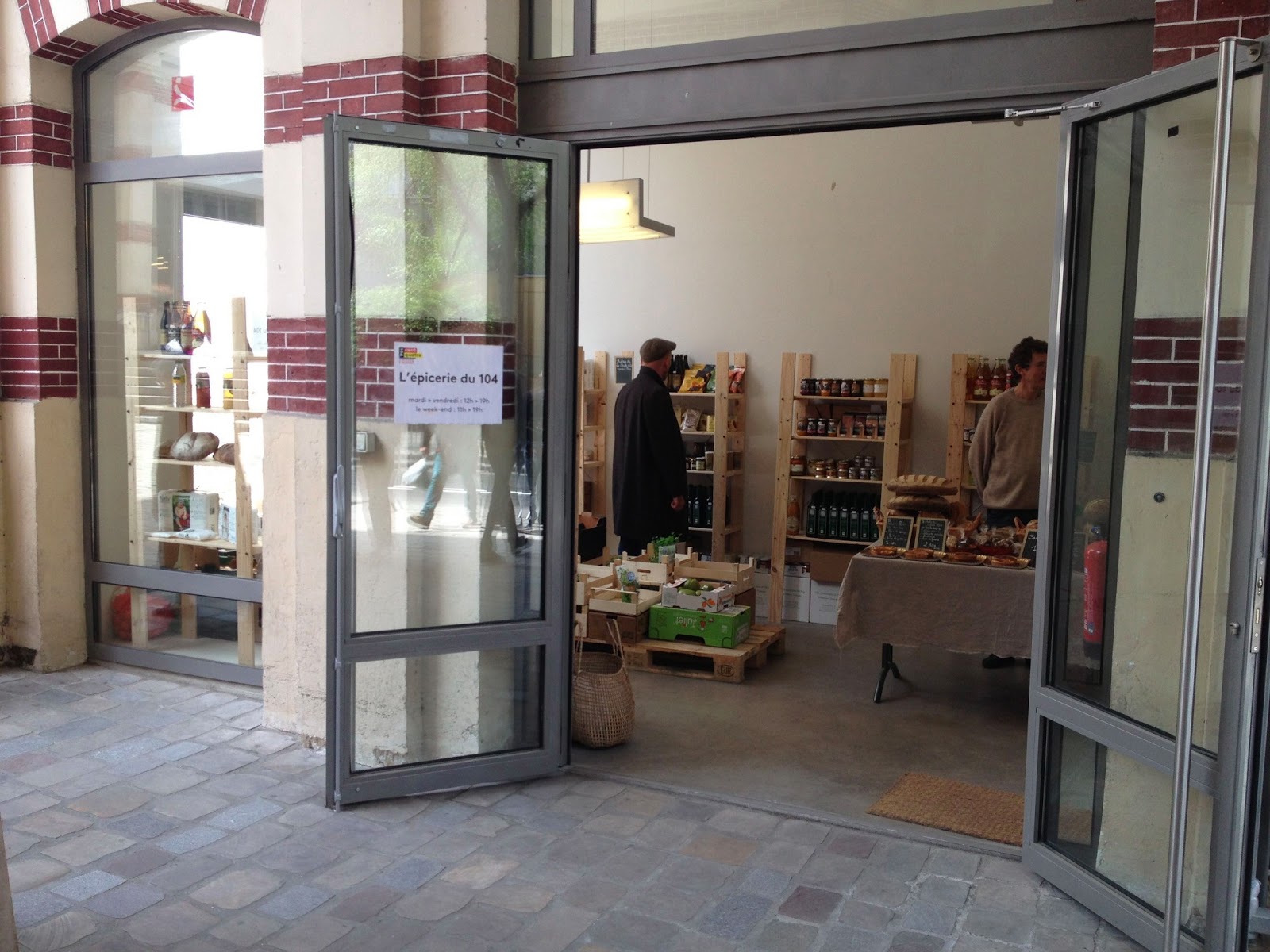
good works: l'épicerie du 104, 75019


The Native Companion has lately succeeded in dragging me to more museums. Each time in the ticket line I confront my reason for usually staying home : a bedraggled queue of hat-haired tourists with their hands full of waffles and soda, whacking me with their overstuffed backbacks. Public art ! But we were lucky the other day on our visit to the Keith Haring exhibition presently on view at Le 104, the 19ème arrondissement's echoing, perpetually under-filled municipal art space. We arrived just before the afternoon rush and took in Haring's brilliant, trumpeting tarpaulin work in relative peace, before we departed to our respective workplaces.

On my way out, I noticed that a little épicerie bio had opened right by the glass doors of Le 104's rue Curial entrance, in a space resembling one of those tollbooths lodged in support columns. I popped my head in and was delighted to discover a slim, affordable selection of natural wines on offer, including, among others, Saone organic vigneron Guy Bussière's marvelous flinty Melon de Bourgogne cuvée, "Phénix."

L'Epicerie du 104 opened February 2nd, I learned. Our late-coming, tentative springtime this year means that the shop is only just now attaining relevance as a perfect pit-stop before a visit to Le 104's exhibit and a picnic in the Jardin d'Eole, the overlooked strip of public greenery wedged between Le 104 and the twisting river of train tracks leading to Gare de l'Est.

10 May 2013

ma dai ! : procopio angelo, 75010


There would not, initially, seem to be much purpose in my writing anything at all about Procopio Angelo, the eponymous restaurant of a popular Tuscan chef in Paris, once based on rue Faubourg St. Honoré, now transplanted to a back road near Colonel Fabien in the 10ème. Procopio's Italian wine list is representative of the genre as one typically encounters it in Paris: a seeming panoply of regional wines, which upon closer inspection turn out to comprise little more than the diverse ranges of a few titanic producers of supermarket wine. Then you have poor Marco Parusso's decent if overmodern Barolos - always the current vintage - sitting there like duck-decoys for the big spenders who stray in.*

But Procopio keeps cropping up in any discussion of Italian food in Paris. No less than two friends whose culinary opinions I otherwise respect have proposed his restaurant to me as an example of "real Italian."

Sociologist Peter L. Berger famously argued that reality itself is a social construction, an interwoven fabric of institutionalised social perceptions. Procopio Angelo is real Italian cuisine, if, like many Paris diners, one disregards the last twenty years' of Italian restaurateurism and continues to define Italian cuisine in opposition to the technique and complexity of a serious restaurant.

06 May 2013

why ask why: la pulperia, 75011


Natural wine enthusiasts are kind of like vegetarians: we know their preferences, but their reasons why diverge wildly. A few natural wine fans are taking an ecological stand. (It stands to reason that most natural wine restaurants in Paris serve sustainable fish.) Other people just want to avoid headaches. Still others - and in this category I would place most of the vignerons I know - have only aesthetics in mind: they promote natural wine because it simply tastes better.

My own reasons for preferring natural wine are complicated, half-aesthetic, quasi-Marxist, cultural preservationist... I can't choose just one. But it seems to me that one would have to be firmly in the pure-aesthetics camp in order to justify serving natural wine beside steaks shipped from Argentina, as chef Fernando de Tomaso does at his 11ème Argentine bistrot La Pulperia.

The practice also identifies the restaurant as being aimed at squarely at native Parisians. Anyone else - all the expats I know and surely every tourist - would prefer, whilst in Paris, to consume any of the numerous renowned varieties of French beef (Charolais, Aubrac, etc.). Many of us have stood by shaking our heads as international meat places like Bang!, The Beef Club, and La Pulperia open, and French restaurant culture sails further into the maw of the global capitalist whale, the belly of which contains everything, as many choices as a Whole Foods Market... Doomsaying aside, La Pulperia boasts pleasing cuisine and a surprisingly deep natural wine list, making it a probably a fine place to return if I ever become truly Parisian. (God help me.)