18 February 2014

pioneers: le tagine, 75011


I started frequenting my friend Marie-Jo Mimoun's adorable Morroccan restaurant Le Tagine about two years ago. Mimoun has a superb little Rhône-focused wine list, featuring, among others, such legends as Domaine Gramenon, Dard et Ribo, and Jean Foillard. Yet on every visit I'm surprised by how little wine is consumed in the place. The haute-Marais clientele, largely white and French (i.e. non-Muslim), seem to stick to beer.

I can only assume it's because Le Tagine doesn't look like a wine place. It looks like a chill spot for some ethnic food with the family on a weeknight. And I get the impression that Paris diners - native and tourist - are more reluctant to purchase serious wine from people who don't look classically French.

Justin E. H. Smith, professor of history and philosophy of science at Université Paris Diderot, recently touched on this bias in a terrific NYTimes Opinion piece, where he astutely cited the link between European nativism and "the celebration of terroir and 'Slow Food'." It's a discomfiting alliance based on resistance to globalism and its effects. At worst, as in the case of Friulian winemaker / hatemonger Fulvio Bressan, the resistance is manifested as outright racism. In France, we see certain slippery creeps organising anti-Muslim protests under the guise of "sausage and wine" parties beside mosques. On a far more innocuous level, you have the fact that quality terroir-driven wines in France - let alone natural wines - are consumed almost exclusively in identifiably French restaurants.

In the case of Le Tagine, an overlooked gem of a restaurant that boasts stupendous service and solid soulful Morroccan cuisine alongside its well-priced wine list, it's a crying shame. On the plus side, there's almost always a six-top free when I need one.

11 February 2014

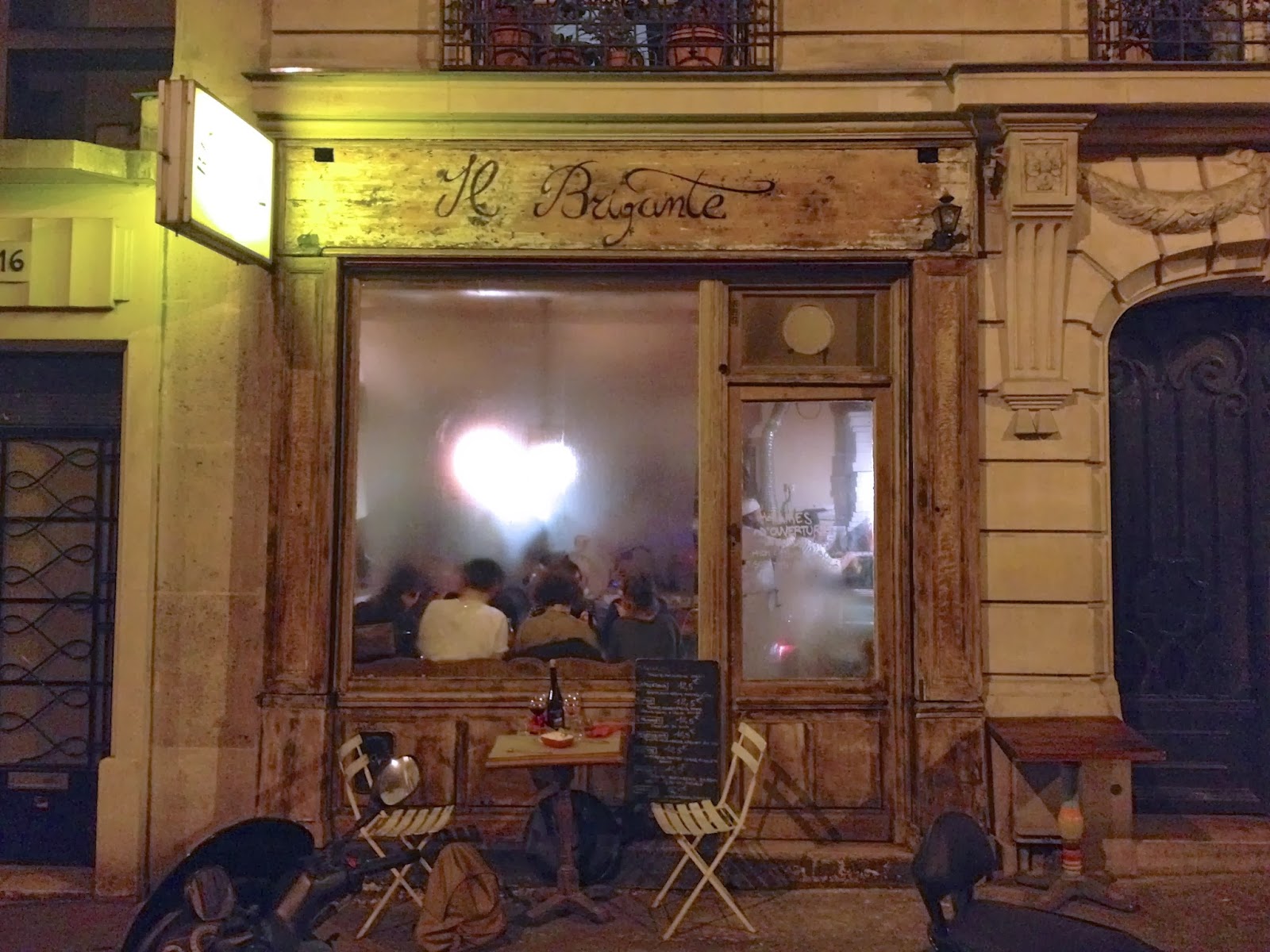
parisian pizza: il brigante, 75018


As a foreigner in Paris of a certain profusely fertile age group, I often wonder what it would be like to raise a child here. These reveries fill me with dread. One day I would wake up surrounded by an ideologically French family. It's cute when French toddlers obediently proffer their cheeks to relative strangers for goodnight kisses before toddling off to bed. It's less cute when French employees explain they took a fourth cigarette break because they needed a little pause.

And it's frankly pathetic that over half the country agrees that François Holland's right to philander with spectacularly clumsiness shouldn't be questioned by journalists. The President's recent press conference reminded me of the climactic scene from the Wizard of Oz: "Pay no attention to the man behind the curtain." (To which the obvious response is, if you want us to do that, you should begin by keeping it behind the curtain.)

But sometimes I wonder if I'm becoming indoctrinated, too. I already demand room-temp cheese and fresh bread wherever I go, which means I can't live anywhere else in the world. And a real red flag went up the other day, when at the devilishly charming Montmartre restaurant Il Brigante I genuinely enjoyed a locally popular foodstuff I've heretofore foresworn entirely: Parisian pizza.

07 February 2014

loire salons 2014: la dive bouteille, les penitantes, la renaissance des appellations, les vins anonymes


If ever you wish to experience an almost out-of-body sense of superfluousness, visit the January Loire salons and tell the natural winemakers you meet that you are a journalist. Of hundreds of winemakers present, only a vanishingly small percentage are subject to the conditions that would warrant paying you any attention whatsoever, i.e. they use the Internet, have wine to sell, and are aware of the commercial value of positive press. I've illustrated the scarcity of this demographic in a handy bubble graphic after the jump.

I never take it personally. Since at present I have the luxury (or misfortune, depending on when you ask me) of not buying and selling wine for a living, I kind of just moon around the various tastings and do my best to make the sort of fleeting interpersonal connections that become useful at later dates, such as when I'm trying to secure interviews, or volunteer for harvest work, or plan bike trips around tasting appointments. "I'm the guy who stared at you and waved from across the restaurant in Angers! Who said hello with from behind the restaurateur accompanying your Canadian importer!" etc. (These are fictitious examples, but not far from reality.)

I leave it to readers to judge whether this constitutes a useful perspective on the Loire salons. This year I accompanied my friend J to La Renaissance des Appellations, Salon Les Penitantes, Les Vins Anonymes, and La Dive Bouteille. What follows are some scattered takeaways.

04 February 2014

beyond izakaya: restaurant 6036, 75011


Last fall I helped my friends from 11ème arrondissement German bar Udo put together a small wine list for their new project, a gallery space and Japanese small-plates restaurant called Düo that opened in October.

If I haven't yet written about Düo, it's because I want to give the team there time to work out the service kinks before I start cheerleading about the place. I figured the concept was original enough - inexpensive Japanese small plates and solid natural wines - that buzz would build of its own accord.

I realised I may have waited too long when the other day, just a few blocks away from Düo, my friend E and I stumbled upon the newly-opened 6036, a SIM-card-sized restaurant serving - what else? - inexpensive Japanese small plates and solid natural wines. I guess it's a full-blown trend already. 6036 bills itself as izakaya, or Japanese bar food, but this is a ruse: it's actually a modest and sincere gastronomic experience, helmed by chef Haruka Casters, formerly sous-chef at 10ème arrondissement tasting-menu destination Abri.

29 January 2014

why we dine out: come a casa, 75011


I still read Pitchfork. But since it now takes less time to download albums than it does to parse reviews, I usually just peek at the point score and make the call myself. I find it's a good way to avoid the publication's increasingly boosterish take on certain handpicked darling bands, a trend that began with Deerhunter and has reached self-parodical peaks with coverage of Savages and Perfect Pussy.*

This past December, Pitchfork cited Perfect Pussy's slight 4-song demo as among the Honorable Mentions for Albums of the Year. When I played it for my friend C, a young gallerist from New Zealand, she wrinkled her nose. "Yeah Bikini Kill blah blah blah, we've heard this before." We agreed that Pitchfork was having an NME moment, a paroxysm of hyperbolic hype about something totally unproven, deriving from the writerly impulse to say things messianically.

Editors are supposed to throw cold water on that sort of thing. The task is arguably more important in food and wine journalism, since readers can't (yet) choose to simply download a meal. It always costs money and time. Quite a few Paris food writers recently had their own NME moments over a shoe-sized Tuscan restaurant by Voltaire called Come a Casa. I duly dined there and came away slightly disappointed - not by the meal, which was basically as advertised, but by Paris food writing.

27 January 2014

feed the captives: freddie's deli, 75011


One of my pet causes is holding writers accountable for use of the words 'hipster' and 'bobo.' Both words are blanket terms that absolve a writer from the responsibility of considering individual subcultures, or whatever it is that unites them at a given address. 'Bobo,' the portmanteau of 'bourgeois' and 'bohemian' that has attained an alarming currency in modern French usage, is all the more egregious for having been coined by NYTimes columnist and malign pseudo-sociological waffler David Brooks.

I mean this as preamble to a discussion of Freddie's Deli, the sandwich joint (not deli) opened last summer on a ripely disused Oberkampf side street by Kristin Frederick, the inspired marketeer behind Paris' first burger truck, Le Camion Qui Fume.

I could blame Paris' "hipsters" and "bobos" for the quasi-ironic glorification of street food that pervades culinary discussion and rewards concepts like Freddie's and Le Camion Qui Fume, which by objective standards produce pretty mediocre product. But what I'd really mean is "young people and Americans and Australians and Brits," and what these demographics share is a dearth of culinary heritage. So rather than dwelling on Frederick's slapdash appropriation of regional US sandwich themes, it seems more worthwhile to note that our attraction to them identifies us as captive victims of agro-industrialism. Sentimentality for cheesesteaks and burgers - recipe-memes that thrive under mass production systems - is our collective Stockholm Syndrome.

13 January 2014

hidden in plain sight: willi's wine bar, 75001


I should clarify by explaining that Willi's Wine Bar, the pioneering Paris wine destination founded in 1980 by British expat Mark Williamson, is only hidden to people like me. For the past four years I've worked a few blocks away from the bar, and until the other week, I'd never been tempted to step inside.

I am, it turns out unreasonably, disinclined towards restaurants known for tote bags and wine-art posters. The children's-book storefront font alone is enough to turn stomachs. Willi's, from the outside, appears to be a wine bar for people who only drink wine when they visit Paris.

Actually, it looks a lot that way from the inside as well. Williamson's decades-long indifference to cool is reflected in the clientele, which I'd wager consists primarily of Paris' least-informed Anglophone tourists and expats, family vacations and business trips whose organisers may have breezed, once, through a Lonely Planet guide from 1997. So upon finally dining at Willi's the other night, I was fairly gobsmacked to discover that Willi's' regulars are, if anything, more informed than me. All this time they've been enjoying, in a friendly, unfussy environment, Paris' greatest Rhône list.

07 January 2014

native success story: pierre sang in oberkampf, 75011


The social media trajectory of Newsweek journalist Janine di Giovanni's recent France-bashing has been far more interesting than the article itself, which was basically a list of right-wing talking points disguised in a beret. Many otherwise liberal friends shared the piece on Facebook and Twitter, perhaps before reading it all the way though. A day later the French press reacted with predictably pedantic and humorless outrage. (Le Monde went so far as to explain the French etymology of the word "entrepreneur," having completely missed the gist of the cliché di Giovanni quoted.) Now the same friends who shared the article in the first place are sharing its rebuttals, having belatedly recognized the article's utter vacuity.

There are two jokes embedded in the kerfuffle surrounding di Giovanni's article. The first is that no one ever reads Newsweek. The second is that French people and expats living in France are utterly irrelevant to the agenda behind the piece, which would appear to be deregulation and further demonization of social security in the USA.

If we nonetheless get roped into the discussion, it's because, by golly, there does seem to be something fundamentally unworldly about contemporary French culture. A journalist like Janine di Giovanni can airily declare that France is prone to navel-gazing, and most expats here - myself included - will instinctively think, "Right on!," only later remembering to scan for rational argumentation, factual accuracy, journalistic scruples, etc. Partly this is what every foreigner living in a foreign land feels, because in traveling to said foreign land one has necessarily become a bit more worldly than its natives who stayed put. But partly this is the fault of self-congratulatory cultural institutions, among them the news outlets that laud restaurants like 11ème arrondissement quasi-gastro outpost Pierre Sang In Oberkampf.

02 January 2014

the decline of : la régalade, 75014, 75001, and 75010


I recently called Nicolas Lacase's 10ème Bistro Bellet "a giant defibrillator for the bistrot genre." So it behooves me to explain why I felt the bistrot genre needed resuscitation. Handily, recent visits to the three locations of chef Bruno Doucet's atrophic La Régalade empire have furnished me with exhibits A, B, and C.

The original La Régalade was founded by chef Yves Camdeborde in 1992 at the far border of the 14ème arrondissement. In its day it was ground zero for the bistronomie movement, in which disaffected young chefs were leaving Michelin-starred kitchens and opening simple bistrots where their gastronomic talents could shine at lower price points.

In America, where we tend to class eating establishments all together as restaurants, encountering gastronomy in a bistrot doesn’t scan as such a big deal. The closest American analogue to the shock of “bistronomie” in French culture is probably that moment in the mid-2000’s when, in certain US cities, it became possible to dine very well from food trucks. But where, just a decade on, most savvy diners I know have all grown quite tired of food trucks (except when drunk), Paris after two decades continues to unthinkingly congratulate any classically-trained chef who deigns to cook without the aid of chandeliers. (C.f. the overrated Restaurant Pierre Sang Boyer in Oberkampf.) The still-successful La Régalade restaurants, collectively, comprise the sacred cow of a bistronomie nostalgia cult, whose membership includes throngs of uncritical diners as well as most of the city's established food critics.

So let's get the knives out, shall we ?

23 December 2013

yonne bike trip: nicolas vauthier / vini viti vinci, avallon


I'll never forget how Le Verre Volé's Cyril Breward once described Nicholas Vauthier's range of low-sulfur north-Burgundian négociant wines to me. The delicate word he used was "perfectible," which is to say, capable of perfection, and by inference, not at all there yet. (This word is a godsend for anyone who must strive to be diplomatic when asked for opinions on friends' wines.)

Vauthier's Vini Viti Vinci wines had appeared seemingly overnight in just about every restaurant and wine shop I frequented. There was nothing not to love about the marginal appellations - Irancy, Bourgogne Epineuil - or the joyously ribald cartoon labels,* which typically depict mustacchioed transexuals and naked women of all races and shapes in suggestive poses. But the wines themselves initially left me a little cold. At best they were stolid examples of their grapes and not great values; at worst they were just plain flawed.

This was a few years back, though. When last June I saw a chance to pass by Vauthier's home-base of Avallon, I lost no time in requesting an appointment. For I'd belatedly learned that Vauthier had co-founded my favorite restaurant, Aux Crieurs du Vin in Troyes. And I'd already noticed his wines had been improving. The Vini Viti Vinci range now contains some very pleasant surprises, both red and white.

18 December 2013

changing the landscape: bistro bellet, 75010


It took me a few years in Paris to appreciate how a single restaurant can cause a seismic shift in the city's dining landscape. Places like Le Verre Volé, Spring, and Au Passage opened as neighborhood spots. But they introduced new dining paradigms to Paris, and quickly became reference points for anyone daring to drag the boulder of French restauration up the hill of contemporary urban life.

To the ranks of those innovators I'd now nominate Nicolas Lacaze's Bistro Bellet, which opened just weeks ago on an excitingly leery stretch of rue du Fauboug Saint-Denis, basically the Cirque du Soleil of sketch. It's an area people keep promising me will gentrify, but until now those promises have seemed about as concrete as reincarnation for the nearly-dead. Bistro Bellet, with its clean décor, laser-sighted service, and conceptual savvy, is like a giant defibrillator for the neighborhood, and the bistrot genre at large.

It's a near-faultless restaurant that serves masterful Provençal-inflected cuisine and well-priced natural wines in a fussless environment from very early (6pm) until very late (midnight). Who's to say whether other restaurants will follow suit, and the innovative idea of turning tables will take root in Paris? For now I'll just say that Bistro Bellet presented one of the most fundamentally satisfying meals I've had all year.

16 December 2013

yonne bike trip: le bougainville, vézelay


Deciding where to dine in Vézelay was an easy decision. We cased restaurant's lining the town's one road and lumped for Le Bougainville, the only restaurant where Michel Tolmer's "Epaule Jété" poster in the window indicated the presence of natural wines.

The poster these days is a reliable, if by no means infallible, indicator of a restaurant that prizes good wine. This in turn is a reliable indicator of a good restaurant. Dining on hunches : it's what you do in the countryside. Like oil prospecting, only less nefarious or profitable.

Anyway, my friends and I hit the motherlode in Vézelay that day. Le Bougainville is the realised idyll of a country bistrot: quaint, welcoming, with a wine list to die for and a superlative cheese plate. And chef-owner Philippe Guillemard and his wife Sylvie are like the angels who admit you to heaven after a lifetime of suffering Parisian hospitality. They're quiet enthusiasts who, from their restaurant perched in the shadow of Vézelay's famous basilica, offer the town's visitors a dining experience to rival the transcendental view up top.

11 December 2013

nice work if you can get it


For once, I've been writing enough bits and bobs for other publications to warrant a brief round-up post.

- For PUNCH magazine in New York I wrote an enthusiastic profile of La Pointe du Grouin, Thierry Breton's elaborately eccentric wine bar by Gare du Nord, which I've previously covered here.

- The website Paris By Mouth kindly indulged my Beaujolais obsession and published two pieces around the release of this year's Nouveau. One was an essay arguing for the relevance of natural Beaujolais Nouveau, tied to a preview of Paris' best release parties. The other was a review of this year's natural Nouveau wines tied to an account of our attempt to cross Paris tasting them all in one night.

- For GREY magazine in New York I conducted an interview with perfumer / photographer / make-up artist Serge Lutens, on the occasion of the pre-release of his new eau de parfum.

The problem is that, with the exception of the Lutens piece, the research and organisation involved in producing the article cost me over half as much as the eventual remuneration. I despair at ever making it all add up. This is why every wine writer you know also tries to sell you holiday gift packs, guided tours, commemorative mugs, etc. 

09 December 2013

kid stuff: 58 qualité street, 75005


My friend Christophe Philippe, the demure and talented chef of Restaurant Christophe in the 5ème arrondissement, has misgivings about his quartier. He rightly feels misunderstood: in the shadow of a tourist attraction like the Panthéon, his eponymous bistrot is a cultish anomoly: a spare, principled space, downright churlish in its refusal to cater to popular tastes. Whereas what the students and visiting families in the area want, judging by the success (or at least, unfathomable persistence) of neighboring businesses, are downmarket shot bars, cheap beer, and anonymous crêperies.

Apparently undaunted, chef Sylvain Sendra and the team from Les Itinéraires opened the abominably-named cave-à-manger 58 Qualité Street late last year just a few paces from Restaurant Christophe. 58 Qualité Street - no relation to the Nestle-owned brand of bad chocolates, ubiquitous at British Christmases - serves simple épicerie cuisine and natural wine non-stop until 11pm every day except Sunday. It could have been intended as a way to make tasteful product available to young audiences in the most informal, unintimidating way possible.

The would be the most charitable way to read 58 Qualité Street. It might also just be an underconceived rush-job of an establishment, without any discernible identity or ambition.

06 December 2013

where the treasure is : la cave des papilles, 75014


On the regrettably rare occasions I find myself strolling around Paris' 14ème arrondissement, I take a great deal of pleasure in the smell of money in the air. I breathe it in, moony-eyed, imagining that by some kind of magical osmosis, I might later discover, upon exiting the métro back at Barbès, an extra 50 centimes in my pocket.

Unlike other wealthy neighborhoods, like the 8ème or the 16ème, the 14ème contains a concentration of actual tasteful goods and services. The entrenched, mostly white families of this quartier purchase meat and bread and wine as I do, only their meat is by Hugo Desnoyer and for bread they have Ridha Khadher.

Their wine, if they have any good sense, comes from La Cave des Papilles, a veritable Ali Baba's cave of the treasures of natural winemaking France.

04 December 2013

yonne bike trip: le vezelien, vezelay


I pretty much fell in love with Vezelay and its lowland twin Saint-Pere in the course of the bike trip through the Yonne back in June. So much so that I revisited both towns again in late July, on a bike trip from a different direction. I was able to confirm that, together, these two discreet little towns have it all. An impressive basilica, a small river, a good local vigneron, an organic brewery, at least one superb chambre d'hôte, and a stunning restaurant, about which more in a subsequent post...

Vezelay also contains, just yards from the basilica, a marvelous local bar, le Vezelien, where my friends and I took refuge during a swift and furious storm that rolled in like divine judgement while we awaited our dinner reservation.

Having optimistically seated ourselves on the otherwise desserted terrace that evening, we hightailed it inside with our beers. There, where in lesser towns we might have encountered a typical soulless PMU-interior, we instead found ourselves in a cozy country pub. Vernissage flyers from the previous three decades papered the walls. Locals engaged us in conversation. A young fellow was busy writing in the corner - with pen and paper ! We weathered the storm in style and trotted off to dinner. It wasn't until I returned in July that I got to experience the salads at Le Vezelien, which approach something like perfection.