27 March 2014

bonne chance: lucien la chance, 75017


A familiar quandary arises when discussing places like charming new 17ème arrondissement wine bar Lucien La Chance. I want to encourage them, because Paris needs more casual, no-reservation places that care about food and wine. But I also want many such places to be better than they presently are.

Preventing improvement is a kind of pervasive municipal campanilismo. (Italian for the local loyalty that extends as far as one's local church steeple or campanile is visible.) Most Paris real estate is tiny, and most Paris businesses are tiny, and if a tiny business is popular with its immediate neighbors, why should the owner care how said business compares to businesses on other side of town, let alone ones in New York or London? The hyperactive Paris-media apparatus to which I contribute doesn't help the situation, and the combined effect is to promote complacency in popular places.

So seems best to call it like it is. Lucien La Chance, which opened last month, is pokey and amateurish, and the scatterbrained natural wine list is laughably imbalanced. Yet I quite like the place and will probably return. What the bar presently lacks in sophistication is more than compensated for by its contemporary, youthful format: like Septime Cave, Touller Outillage, La Buvette, and La Pointe du Grouin before it, Lucien La Chance is a great chill place for an unstructured apéro with an unconfirmed number of flaky friends. Owner Guillaume Blanchot has the right general ideas about wine and product, and an amusing fondness for disco.

24 March 2014

heaven is a place...: café trama, 75006


In the course of an otherwise friendly conversation the other day, a chef-restaurateur I know asked me in exasperation whether Paris contained any establishments I actually like.

I protested that, on the contrary, my tastes are quite easily discerned. I like boring restaurants best. One gets so sick of interesting restaurants.

My favorite meals in recent memory are those that would interest most dedicated gastronomic adventurers the least. The first was Bistro Bellet, Nico Lacaze's spiffing bistrot re-boot on the rue du Faubourg Saint Denis. More recently, I fell out of my chair for Café Trama, an impeccably tasteful rue du Cherche Midi restaurant whose reputation as a bourgeois canteen short-sells the enormity of its achievement. With a mild, unshowy menu by chef Bruno Schaeffer, a brilliant wine list by Le Rouge et Le Blanc editor Paul Hayat, and a welcoming, well-appointed dining room run by owner Marion Trama, Café Trama is like a beacon showing the way home to wayward novelty concepts citywide. All it does is positively ace the basics of restaurateurism, something everyone else has seemingly forgotten to do.

19 March 2014

a higher pursuit: chez aline, 75011


Chez Aline,* the thimble-sized lunch spot run out of a converted horse butchery by well-traveled chef Delphine Zampetti, has been open for almost two years now, no doubt providing daily delight to roughly sixty to eighty tasteful people who live or work right nearby.

For the rest of us - for me at least - the address is semi-mythical for how difficult it is to find an occasion to dine there. Chez Aline is open only at lunch, there are just four two-tops outside, and roughly the same number of bar-stools on the interior. So even when one wishes to cross town for lunch Chez Aline, a seat is far from guaranteed. By 3:30pm she has often run out of most of the menu.

To hell with it, though: it's usually worth the trip. Zampetti has created something like a jewelbox diorama of the low-key chef's ideal restaurant: a soulful space to cook for mainly friends and neighbors, with low overhead, zero design, and nights off to permit family life. If a chef were to renounce worldly pursuits and devote herself to a zen regimen of simple healthful toil, this is the restaurant that would result.

17 March 2014

somm needed? : restaurant roca, 75017


The friends I brought to Roca during Fashion Week probably thought I was taking them to Beauvais Airport. The restaurant, a charming if somewhat faceless contemporary effort by Julien Ross, a cousin of the owner of 10ème arrondissement middleweights L'Office and Le Richer, is not situated in the pleasant, blithely unworldly Batignolles segment of the 17eme arrondissement. It's situated in the armpit thereof, just a stones throw from the peripherique.

In any other quartier, Roca would be raking it in. Chef Alexandre Giesbert, formerly of Le Richer, cooks precisely what Parisians wish to eat these days: sweetly accessible variations on menu staples, finessed to a sheen and enlivened with the odd exotic ingredient (seaweed tapenade, kumquat). Prices are extremely reasonable.

But Giesbert's cuisine is hobbled by the restaurant's far-flung location, and an almost punitively boring wine list. I nonetheless quite enjoyed our meal at Roca. Where ordinarily I'd loudly proclaim that the restaurant needs a sommelier, I find myself torn. Because our server that evening at Roca did something no sommelier in Paris has, to my knowledge, ever done: he promptly agreed that my first bottle of Marsannay was corked, and fetched another bottle without debate.

13 March 2014

here's your future: frenchie to go, 75002


In the not-too-distant future, when Paris drops the pretense of being French, Le Fooding will organise several multinational corporations to erect a statue in honor of Frenchie founder Gregory Marchand.

Smaller versions of the same statue made of Claudio Corallo chocolate will be sold in Frenchie To Go, which by then will be a fixture in frequent-flyer lounges throughout the western hemisphere. As now, the original Frenchie To Go location on the rue du Nil will be frequented principally by foreigners for whom the experience of eating a pulled pork sandwich in the City of Light is unforgettably tickling. "Can you believe it?" they'll beam at one another between bites. "We're in Paris!"

The attraction-packed rue du Nil, of course, will be unremarkable by then. For it will have become an urban planning template for much of the city. (Already, some well-intentioned financeers have plans to create another foodie wonderland by Arts et Metiers.) Actual Parisians will have long decamped outside la Peripherique, where a fugitive culture of sitting around consuming nothing in well-preserved cafés will persist. For city real estate - even of the momentary kind, like a seat at a restaurant - will be priced beyond the means of all but visiting princelings. The latter will flock to Paris from all over the world in order to taste, at Frenchie To Go and its many imitators, the absolutely definitive versions of the cuisine they remember from turn-of-the-century food blogs.

10 March 2014

you've goust to be kidding: goust, 75002


A magazine I write for sometimes called Punch recently published two interesting pieces about what it means to be a sommelier. The comment threads beneath these articles quickly devolved to something approaching trench warfare, with lines clearly drawn between those who consider "sommelier" a role, like an emcee, and those who consider the term to be more like a title or accreditation, like "PhD" or "Licensed Beautician."

Personally, I would very much like to have already internalized and recited the industry catechism required for certification by any of the big sommelier accreditation bodies. Then my opposition to them could be taken seriously. As it is, any criticism I might offer would rightly have the ring of sour grapes.

I'll stay mum for that reason. I will however say that for a sommelier to emblazon his restaurant's menus with his name and the epithet "Best Sommelier in the World," as title-winner Enrico Bernardo does at his recently Michelin-annointed restaurant Goust, is a laughable act of hubris, one that inadvertently seems to trivialize the responsibilities of a sommelier. It's like calling a certain chair the Best Chair in the World. Ultimately, it's a place where you sit, not terribly dissimilar to the second or even the third-best chair in the world.  A restaurant is a place where you eat and a sommelier is the fellow who helps you navigate the wine list. To truly require the utmost services of the Best Chair in the World or the Best Sommelier in the World, one would in both cases have to be a very demanding ass.

The rest of us who enter Goust planning merely to eat food and drink wine are unfortunately in for a minor letdown, since for all its rigor the sommelier competition Bernardo won had no section on good taste in restaurateurism.

18 February 2014

pioneers: le tagine, 75011


I started frequenting my friend Marie-Jo Mimoun's adorable Morroccan restaurant Le Tagine about two years ago. Mimoun has a superb little Rhône-focused wine list, featuring, among others, such legends as Domaine Gramenon, Dard et Ribo, and Jean Foillard. Yet on every visit I'm surprised by how little wine is consumed in the place. The haute-Marais clientele, largely white and French (i.e. non-Muslim), seem to stick to beer.

I can only assume it's because Le Tagine doesn't look like a wine place. It looks like a chill spot for some ethnic food with the family on a weeknight. And I get the impression that Paris diners - native and tourist - are more reluctant to purchase serious wine from people who don't look classically French.

Justin E. H. Smith, professor of history and philosophy of science at Université Paris Diderot, recently touched on this bias in a terrific NYTimes Opinion piece, where he astutely cited the link between European nativism and "the celebration of terroir and 'Slow Food'." It's a discomfiting alliance based on resistance to globalism and its effects. At worst, as in the case of Friulian winemaker / hatemonger Fulvio Bressan, the resistance is manifested as outright racism. In France, we see certain slippery creeps organising anti-Muslim protests under the guise of "sausage and wine" parties beside mosques. On a far more innocuous level, you have the fact that quality terroir-driven wines in France - let alone natural wines - are consumed almost exclusively in identifiably French restaurants.

In the case of Le Tagine, an overlooked gem of a restaurant that boasts stupendous service and solid soulful Morroccan cuisine alongside its well-priced wine list, it's a crying shame. On the plus side, there's almost always a six-top free when I need one.

11 February 2014

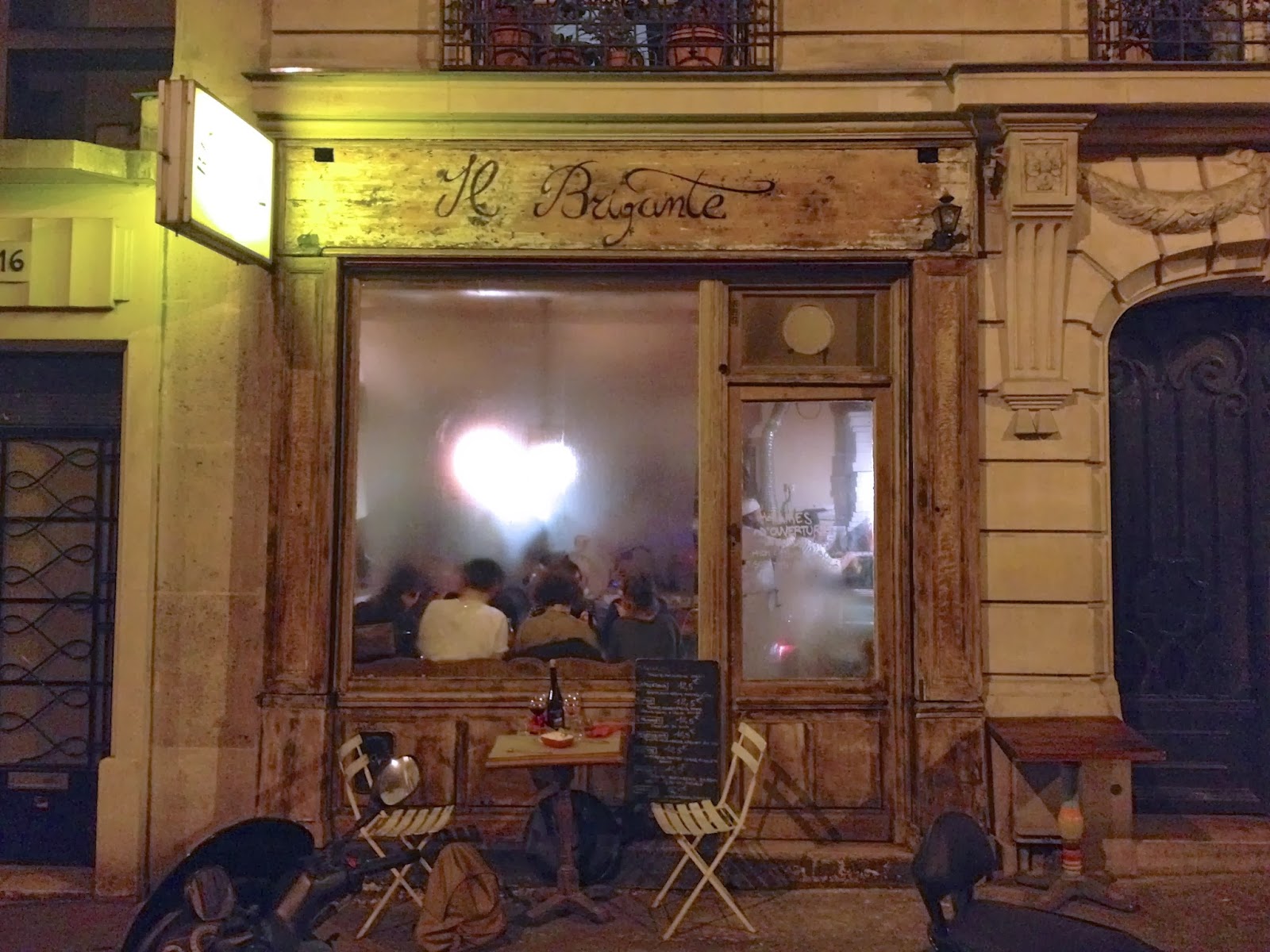
parisian pizza: il brigante, 75018


As a foreigner in Paris of a certain profusely fertile age group, I often wonder what it would be like to raise a child here. These reveries fill me with dread. One day I would wake up surrounded by an ideologically French family. It's cute when French toddlers obediently proffer their cheeks to relative strangers for goodnight kisses before toddling off to bed. It's less cute when French employees explain they took a fourth cigarette break because they needed a little pause.

And it's frankly pathetic that over half the country agrees that François Holland's right to philander with spectacularly clumsiness shouldn't be questioned by journalists. The President's recent press conference reminded me of the climactic scene from the Wizard of Oz: "Pay no attention to the man behind the curtain." (To which the obvious response is, if you want us to do that, you should begin by keeping it behind the curtain.)

But sometimes I wonder if I'm becoming indoctrinated, too. I already demand room-temp cheese and fresh bread wherever I go, which means I can't live anywhere else in the world. And a real red flag went up the other day, when at the devilishly charming Montmartre restaurant Il Brigante I genuinely enjoyed a locally popular foodstuff I've heretofore foresworn entirely: Parisian pizza.

07 February 2014

loire salons 2014: la dive bouteille, les penitantes, la renaissance des appellations, les vins anonymes


If ever you wish to experience an almost out-of-body sense of superfluousness, visit the January Loire salons and tell the natural winemakers you meet that you are a journalist. Of hundreds of winemakers present, only a vanishingly small percentage are subject to the conditions that would warrant paying you any attention whatsoever, i.e. they use the Internet, have wine to sell, and are aware of the commercial value of positive press. I've illustrated the scarcity of this demographic in a handy bubble graphic after the jump.

I never take it personally. Since at present I have the luxury (or misfortune, depending on when you ask me) of not buying and selling wine for a living, I kind of just moon around the various tastings and do my best to make the sort of fleeting interpersonal connections that become useful at later dates, such as when I'm trying to secure interviews, or volunteer for harvest work, or plan bike trips around tasting appointments. "I'm the guy who stared at you and waved from across the restaurant in Angers! Who said hello with from behind the restaurateur accompanying your Canadian importer!" etc. (These are fictitious examples, but not far from reality.)

I leave it to readers to judge whether this constitutes a useful perspective on the Loire salons. This year I accompanied my friend J to La Renaissance des Appellations, Salon Les Penitantes, Les Vins Anonymes, and La Dive Bouteille. What follows are some scattered takeaways.

04 February 2014

beyond izakaya: restaurant 6036, 75011


Last fall I helped my friends from 11ème arrondissement German bar Udo put together a small wine list for their new project, a gallery space and Japanese small-plates restaurant called Düo that opened in October.

If I haven't yet written about Düo, it's because I want to give the team there time to work out the service kinks before I start cheerleading about the place. I figured the concept was original enough - inexpensive Japanese small plates and solid natural wines - that buzz would build of its own accord.

I realised I may have waited too long when the other day, just a few blocks away from Düo, my friend E and I stumbled upon the newly-opened 6036, a SIM-card-sized restaurant serving - what else? - inexpensive Japanese small plates and solid natural wines. I guess it's a full-blown trend already. 6036 bills itself as izakaya, or Japanese bar food, but this is a ruse: it's actually a modest and sincere gastronomic experience, helmed by chef Haruka Casters, formerly sous-chef at 10ème arrondissement tasting-menu destination Abri.

29 January 2014

why we dine out: come a casa, 75011


I still read Pitchfork. But since it now takes less time to download albums than it does to parse reviews, I usually just peek at the point score and make the call myself. I find it's a good way to avoid the publication's increasingly boosterish take on certain handpicked darling bands, a trend that began with Deerhunter and has reached self-parodical peaks with coverage of Savages and Perfect Pussy.*

This past December, Pitchfork cited Perfect Pussy's slight 4-song demo as among the Honorable Mentions for Albums of the Year. When I played it for my friend C, a young gallerist from New Zealand, she wrinkled her nose. "Yeah Bikini Kill blah blah blah, we've heard this before." We agreed that Pitchfork was having an NME moment, a paroxysm of hyperbolic hype about something totally unproven, deriving from the writerly impulse to say things messianically.

Editors are supposed to throw cold water on that sort of thing. The task is arguably more important in food and wine journalism, since readers can't (yet) choose to simply download a meal. It always costs money and time. Quite a few Paris food writers recently had their own NME moments over a shoe-sized Tuscan restaurant by Voltaire called Come a Casa. I duly dined there and came away slightly disappointed - not by the meal, which was basically as advertised, but by Paris food writing.

27 January 2014

feed the captives: freddie's deli, 75011


One of my pet causes is holding writers accountable for use of the words 'hipster' and 'bobo.' Both words are blanket terms that absolve a writer from the responsibility of considering individual subcultures, or whatever it is that unites them at a given address. 'Bobo,' the portmanteau of 'bourgeois' and 'bohemian' that has attained an alarming currency in modern French usage, is all the more egregious for having been coined by NYTimes columnist and malign pseudo-sociological waffler David Brooks.

I mean this as preamble to a discussion of Freddie's Deli, the sandwich joint (not deli) opened last summer on a ripely disused Oberkampf side street by Kristin Frederick, the inspired marketeer behind Paris' first burger truck, Le Camion Qui Fume.

I could blame Paris' "hipsters" and "bobos" for the quasi-ironic glorification of street food that pervades culinary discussion and rewards concepts like Freddie's and Le Camion Qui Fume, which by objective standards produce pretty mediocre product. But what I'd really mean is "young people and Americans and Australians and Brits," and what these demographics share is a dearth of culinary heritage. So rather than dwelling on Frederick's slapdash appropriation of regional US sandwich themes, it seems more worthwhile to note that our attraction to them identifies us as captive victims of agro-industrialism. Sentimentality for cheesesteaks and burgers - recipe-memes that thrive under mass production systems - is our collective Stockholm Syndrome.

13 January 2014

hidden in plain sight: willi's wine bar, 75001


I should clarify by explaining that Willi's Wine Bar, the pioneering Paris wine destination founded in 1980 by British expat Mark Williamson, is only hidden to people like me. For the past four years I've worked a few blocks away from the bar, and until the other week, I'd never been tempted to step inside.

I am, it turns out unreasonably, disinclined towards restaurants known for tote bags and wine-art posters. The children's-book storefront font alone is enough to turn stomachs. Willi's, from the outside, appears to be a wine bar for people who only drink wine when they visit Paris.

Actually, it looks a lot that way from the inside as well. Williamson's decades-long indifference to cool is reflected in the clientele, which I'd wager consists primarily of Paris' least-informed Anglophone tourists and expats, family vacations and business trips whose organisers may have breezed, once, through a Lonely Planet guide from 1997. So upon finally dining at Willi's the other night, I was fairly gobsmacked to discover that Willi's' regulars are, if anything, more informed than me. All this time they've been enjoying, in a friendly, unfussy environment, Paris' greatest Rhône list.

07 January 2014

native success story: pierre sang in oberkampf, 75011


The social media trajectory of Newsweek journalist Janine di Giovanni's recent France-bashing has been far more interesting than the article itself, which was basically a list of right-wing talking points disguised in a beret. Many otherwise liberal friends shared the piece on Facebook and Twitter, perhaps before reading it all the way though. A day later the French press reacted with predictably pedantic and humorless outrage. (Le Monde went so far as to explain the French etymology of the word "entrepreneur," having completely missed the gist of the cliché di Giovanni quoted.) Now the same friends who shared the article in the first place are sharing its rebuttals, having belatedly recognized the article's utter vacuity.

There are two jokes embedded in the kerfuffle surrounding di Giovanni's article. The first is that no one ever reads Newsweek. The second is that French people and expats living in France are utterly irrelevant to the agenda behind the piece, which would appear to be deregulation and further demonization of social security in the USA.

If we nonetheless get roped into the discussion, it's because, by golly, there does seem to be something fundamentally unworldly about contemporary French culture. A journalist like Janine di Giovanni can airily declare that France is prone to navel-gazing, and most expats here - myself included - will instinctively think, "Right on!," only later remembering to scan for rational argumentation, factual accuracy, journalistic scruples, etc. Partly this is what every foreigner living in a foreign land feels, because in traveling to said foreign land one has necessarily become a bit more worldly than its natives who stayed put. But partly this is the fault of self-congratulatory cultural institutions, among them the news outlets that laud restaurants like 11ème arrondissement quasi-gastro outpost Pierre Sang In Oberkampf.

02 January 2014

the decline of : la régalade, 75014, 75001, and 75010


I recently called Nicolas Lacase's 10ème Bistro Bellet "a giant defibrillator for the bistrot genre." So it behooves me to explain why I felt the bistrot genre needed resuscitation. Handily, recent visits to the three locations of chef Bruno Doucet's atrophic La Régalade empire have furnished me with exhibits A, B, and C.

The original La Régalade was founded by chef Yves Camdeborde in 1992 at the far border of the 14ème arrondissement. In its day it was ground zero for the bistronomie movement, in which disaffected young chefs were leaving Michelin-starred kitchens and opening simple bistrots where their gastronomic talents could shine at lower price points.

In America, where we tend to class eating establishments all together as restaurants, encountering gastronomy in a bistrot doesn’t scan as such a big deal. The closest American analogue to the shock of “bistronomie” in French culture is probably that moment in the mid-2000’s when, in certain US cities, it became possible to dine very well from food trucks. But where, just a decade on, most savvy diners I know have all grown quite tired of food trucks (except when drunk), Paris after two decades continues to unthinkingly congratulate any classically-trained chef who deigns to cook without the aid of chandeliers. (C.f. the overrated Restaurant Pierre Sang Boyer in Oberkampf.) The still-successful La Régalade restaurants, collectively, comprise the sacred cow of a bistronomie nostalgia cult, whose membership includes throngs of uncritical diners as well as most of the city's established food critics.

So let's get the knives out, shall we ?

23 December 2013

yonne bike trip: nicolas vauthier / vini viti vinci, avallon


I'll never forget how Le Verre Volé's Cyril Breward once described Nicholas Vauthier's range of low-sulfur north-Burgundian négociant wines to me. The delicate word he used was "perfectible," which is to say, capable of perfection, and by inference, not at all there yet. (This word is a godsend for anyone who must strive to be diplomatic when asked for opinions on friends' wines.)

Vauthier's Vini Viti Vinci wines had appeared seemingly overnight in just about every restaurant and wine shop I frequented. There was nothing not to love about the marginal appellations - Irancy, Bourgogne Epineuil - or the joyously ribald cartoon labels,* which typically depict mustacchioed transexuals and naked women of all races and shapes in suggestive poses. But the wines themselves initially left me a little cold. At best they were stolid examples of their grapes and not great values; at worst they were just plain flawed.

This was a few years back, though. When last June I saw a chance to pass by Vauthier's home-base of Avallon, I lost no time in requesting an appointment. For I'd belatedly learned that Vauthier had co-founded my favorite restaurant, Aux Crieurs du Vin in Troyes. And I'd already noticed his wines had been improving. The Vini Viti Vinci range now contains some very pleasant surprises, both red and white.